CET repeater case: HC defers hearing to September 22

Highlights
  • The High Court on Monday adjourned the hearing of the appeals, filed challenging the order passed by the single judge in connection with the Karnataka Common Entrance Test (K-CET) repeater students’ issue, to September 22.
  • A division bench, headed by Acting Chief Justice Alok Aradhe, granted time to the Additional Advocate General (AAG) to appear for the state government enabling him to find a solution.
  • The appeals have been filed by both the state government and the Karnataka Examinations Authority (KEA).
  • AAG Dhyan Chinnappa requested for an adjournment to find a solution to the situation which has arisen on account of the order passed by a single bench on September 3, 2022, in a batch of petitions filed by the 2021 batch CET repeater students.
  • The bench adjourned the hearing, observing orally that if the state government comes up with a solution that is acceptable to everyone, the issue can be sorted out.
  • Earlier in his brief submission, AAG stated that around 23,000 repeaters had not written their (second) PUC examination during 2021, while the order of the single bench amounted to equating them with around 1,75,000 fresher students, who did write the PUC examination.
  • On September 3, 2022, the single bench directed the authorities to redo the CET rankings for admission to undergraduate courses in Engineering and Technology for the academic year 2022-23 by considering both PU and CET marks in a 50:50 ratio.
  • The single bench had directed the authorities to conduct the redo exercised strictly in accordance with the Rule 3 and 4 of the Karnataka Selection of Candidates for Admission to Government seats in Professional educational institutions Rules, 2006 and without reference to proviso inserted by a government order dated September 1, 2021.

Karnataka govt leasing e-buses to privatise RTCs: Employees’ League

Highlights
  • The Karnataka State Road Transport Employees’ League has said that the state and the central governments are using electric bus procurement as a tool to privatise road transport corporations (RTC).
  • Members of the League, who held a press conference on Monday,   criticised the gross cost model used for leasing buses from private companies.
  • Referring to Transport Minister R Sriramulu’s announcement that 35,000 e-buses will be leased by 2030, the president of League R Chandrashekhar said the governments are not allowing the RTCs to purchase the e-buses.
  • “Instead, we are made to lease the buses and pay the private companies, who also provide drivers. By 2030, all buses will be private buses. The RTCs will be virtually a private entity. Will this not take away jobs of thousands of people?” he asked.
  • He said such a transformation was already taking place in some depots, like Yelahanka, where all drivers are from the company providing the e-bus. “Neither the RTCs nor the public will gain anything from this model. Workers of the four RTCs will organise a struggle against the privatisation,” he said.
  • The league, which organised strikes of the four RTC workers in December 2020 and April 2021, alleged that the management was targeting those who participated in the strikes despite the assurance from the government.
  • He referred to the incidents of four RTC workers committing suicide in the last three months and blamed the deaths on the officials.
  • “The government promised to take back the workers who were dismissed for participating in the strike. However, the management is imposing undue conditions to restore their jobs,” Chandrashekhar said adding that many workers are forced to live without wages for 17 months.
  • He demanded that the police cases should be withdrawn. “We held a strike seeking fulfilment of legitimate demands. One of our demands is to provide salaries on par with government employees who earn 40% more than us,” he said.
  • The league said the government could not cite the poor financial conditions of the RTCs to deny the rightful wages to the workers. It said the government should focus on addressing the policy crisis.
  • “Diesel is sold at Rs 88/litre in retail but the BMTC and other RTCs which buy in wholesale are charged Rs 105/litre. The rates should have been less than the retail price for RTCs. On the other hand, the passenger fares are not hiked. So, the BMTC is earning revenue of Rs 35/km while spending Rs 73/km. Workers can’t be blamed for this crisis,” Chandrashekhar said.

Karnataka High Court ignored law in allowing FIR, B S Yediyurappa tells SC

Highlights
  • Former Karnataka Chief Minister B S Yediyurappa on Monday told the Supreme Court that the Karnataka High Court ignored the statutory provision and the binding nature of the top court’s judgement to allow lodging of a corruption case against him without requisite sanction.
  • Appearing for the politician, senior advocate Mukul Rohatgi, along with senior advocates Sidharth Luthra and Siddharth Dave submitted before a bench of Justices D Y Chandrachud and Hima Kohli that the High Court had wrongly interpreted a reference made to larger bench on question of sanction to allow the probe against the leader.
  • “Law, as of now, is that a sanction from competent authority is a pre condition. But the High Court reversed it, even though sanction was positively refused in my case,” Rohatgi said.
  • The High Court said the sanction is only at the stage of taking cognisance, while ignoring Section 17 (A) of the Prevention of Corruption Act, 2018, which stated no inquiry or enquiry or investigation in case of public servants can be carried out without approval of the appropriate authority.
  • The bench, which conducted a brief hearing, put the special leave petition filed by Yediyurappa for hearing on Friday.
  • The court said, it would prefer to hear the arguments on behalf of activist-complainant T J Abraham, before issuing notice in the matter.
  • The Karnataka High Court had, in an order earlier on September 7, held that the rejection of sanction would not come in the way of proceedings against Yediyurappa.
  • The case related to allegation of  bribes to the tune of Rs 12 crore to award a BDA contract for a construction firm to build a housing complex for the government during his tenure as CM in 2019-21.
An FIR had already been lodged against the Karnataka CM, his family members and others on September 16.

Karnataka to introduce moral education in schools from December

Highlights
  • The state government will introduce moral education in schools from December that will include the Bhagavad Gita, the Legislative Council was told on Monday.
  • School Education & Literacy Minister B C Nagesh told the Council that there is no proposal before the government to make Bhagavad Gita a standalone learning component.
  • He was replying to MLC M K Pranesh who asked what stopped the government from introducing the Bhagavad Gita “when no one is opposed to it”.
  • “There is no proposal before the government to teach the Bhagavad Gita in textbooks, but it will be included in moral education,” he said, adding that it would be introduced from December this academic year.
  • Nagesh said there is no decision yet on the kind of moral education that needs to be introduced. “We will constitute an expert committee that will recommend on moral education. Based on the committee’s report, we will decide about what should be taught under moral education,” Nagesh added.
  • According to the minister, students will neither be assessed on moral education nor will there be an exam.
  • In the March legislature session, lawmakers had demanded that moral education be introduced in schools.
Meanwhile, Nagesh assured the Council that the government would take necessary measures to rectify mistakes in textbooks regarding Indian history.

Karnataka floods: School submerged, students study in temple

Highlights
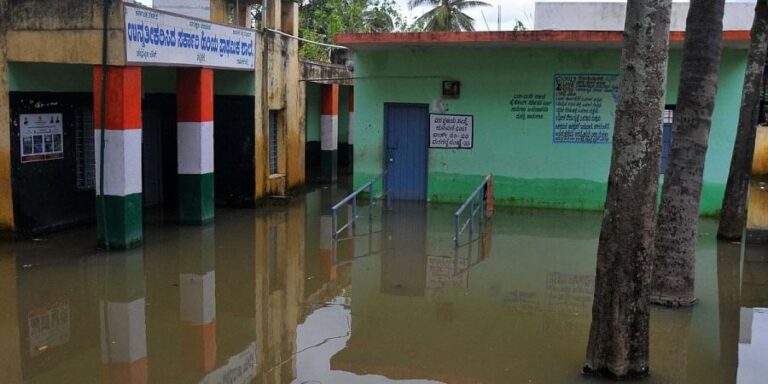
  • CHANNAPATNA(RAMANAGARA DIST) : It has been three weeks since Ramanagara district was pounded by heavy rain, flooding many areas. But students and teachers of the Government Upgraded Higher Primary School in Thattekere area of Channapatna town still cannot enter their school as four feet of water is standing on the premises, making it inaccessible.
  • Local authorities have not taken any action to remove water from the school, while the students, left with not other option, are attending classes at a nearby temple. Thattekere is around 60 km from Bengaluru and 11 km from Ramanagara. The school has more than 60 students from Standards one to eight, five teachers and two staff members, including cooks to prepare mid-day meals.
Lack of toilets affects teachers, girl students
The school was flooded on August 26, a week before the Gowri-Ganesha festival, after a small waterbody nearby breached. Lakshmi, who has been working as a cook at the school for the last 20 years, said all the grains kept for mid-day meals was spoilt. “We cannot even enter the school as water is around four feet,” she explained. “The school is in a low-lying area.

Even if water is removed, it keeps entering from the nearby lake,” she added. For drinking and cooking purposes, water is being sourced from local residents. The classes are being held at Beereshwara Swamy Temple at Kattemane, which is in the middle of a residential area.

Children of all classes are packed into a small space. For a few days, residents pooled in money and ration to prepare the mid-day meals. Some days later, authorities sent the foodgrains. With no place to prepare meals, Lakshmi is cooking at the house of a nearby resident.

The students are also finding it difficult as there are no toilets, while some residents have allowed teachers and girl students to use their washrooms. The Education Department has started constructing a new building for the school.

Students and teachers hope at least one classroom is ready in two months. “But the toilets are yet to be constructed at the new building. Education Department should construct toilets, otherwise many girl students will quit studies,” a resident said.
No burial ground, Dalit woman laid to rest by roadside in Karnataka

Highlights
  • Hanumakka (75), a Dalit woman who passed away in Bijwara village of Madhugiri taluk in Tumakuru, had a long and troubled last journey on Sunday. Denied entry into the village burial ground, her wailing family finally laid to rest by the roadside, and conducted the last rites.
  • Dalit activists responded in anger, saying this is not a problem unique to this area, and that more than 1,000 villages and hamlets across the state do not have designated burial grounds for Dalits. Activist Vijay Sreenivasa said, “It has been a problem for a long time. There is no conviction among political parties to ensure dignity for Dalits. If there is no space, the government should buy land.”
  • Dalit Janandolana activist Narasimha Murthy said, “There are about 200 villages in Tumakuru district, which have no burial grounds for Dalits.’’  Law and Parliamentary Affairs Minister and Chikkanayakanahalli MLA J C Madhuswamy said,  “It has come to my notice. A person has claimed that land allocated for the burial ground is his.
  • I will hold a meeting with the Assistant Commissioner and officials to sort out the problem on Monday. Almost 90 per cent of villages have burial grounds. Today, someone had come to me from Sira with a similar issue.’’
  • Former District Minister of Tumakuru Dr G Parameshwara who was previously elected MLA from Madhugiri but is now MLA from Koratgere said, “I am aware of Bijwara which has about 150 Dalit houses, I will speak to the officials.’’

Drug shortage in Karnataka, health department faces bribe heat

Highlights
  • Hospitals in Karnataka are witnessing a shortage of drugs and medical supplies, with the ongoing fulfilment process of the state health centre’s demand list for the year 2020-21, as mentioned in a letter by Health and Family Welfare Services dated September 14.
  • Out of 445 medicines, the tender process of 210 medicines has been completed, but is ongoing for the remaining 235 drugs, and is expected to take around 60 days to be completed. The department is trying to procure the medicines locally for a temporary period, to overcome the ongoing shortage. According to the letter, there is a shortage of 44 essential drugs currently in hospitals across the state.
  • Sources also raised concerns of shortage of medical supplies, like IV fluids, painkillers, paracetamol tablets, disposable cannulas, syringes, surgical sutures etc regularly used in government hospitals and PHCs.
  • Groups of vendors associated with the Karnataka State Medical Supplies Corporation Limited (KSMSCL) for drugs and medical supplies have alleged that the department seeks bribes to clear pending bills.
    A vendor said the department was made to centralise medical supplies, however, mismanagement had caused the opposite. They said that during the Covid pandemic, a lot of emergency procurement was done and vendors supplied medicines/equipment going beyond their reach. However, post delivery of products, they faced many issues with clearance of EMD (Earnest Money Deposit) or their pending bills.
  • Many bills remain pending until now. Companies like Biocon Biologics, Capital Biotech, Juggat Pharma have written to the department requesting clearance of bills, which can mount to over Rs 100 crore.
    Biocon Biologics recently wrote to the Health department, regarding dues in payment for supplies of Remdesivir during Covid-19 second wave. The letter mentioned delay in clearance of Rs 63.34 lakh for supplies, and Rs 43.14 lakh worth of deposit.
  • Constant change of department heads caused inconvenience in terms of management, vendors complained. Due to this, lower ranked officers created chaos in terms of selective clearance of bills, another vendor alleged. Participation and procurement of tenders by smaller companies was also raised, alleging lobbying and favouritism towards certain companies. The department was allegedly drawing up drafts, sidelining certain companies for their automatic removal from the tendering process.
  • Despite numerous calls to  department of KSMSCL, there was no response regarding alleged bribery, pending bills and mismanagement in the department.

Congress won’t come to power in 2023 polls: BS Yediyurappa

Highlights
  • Former chief minister B S Yediyurappa on Sunday predicted that the Congress will not come to power in the 2023 Assembly elections.
  • Speaking to reporters at Hubballi airport on Sunday Yediyurappa said that the people of Karnataka were in favour of the BJP and Prime Minister Narendra Modi. He said he will launch state-wide tour on September 22 to galvanize the party ahead of Assembly polls.

Power subsidy for SC/STs from this month: Karnataka CM

Highlights
  • Chief minister Basavaraj Bommai of Sunday rejected claims by Opposition parties that the government had withdrawn the scheme which assured 75 units of free electricity per month to Scheduled Castes and Scheduled Tribes families.
  • Speaking at an event organised by the Karnataka Bhovi Welfare Association, he said that the scheme will not be withdrawn ‘at any cost’. The scheme will be simplified further and subsidies will be provided to farmers from this month, he said. The Bommai administration had in May raised the free power subsidy from 40 units to 75 units per month to SC/ST communities.

Cauvery: Tamil Nadu got 3 times the yearly allocation in just 4 years

Highlights
  • The state has released 239 tmcft of excess Cauvery water to Tamil Nadu between June 2022 and September 2022, thanks to copious rainfall in the monsoon months.
  • In a reply to a query raised by MLC Dinesh Gooligowda, Water Resources Minister Govind Karjol told Council, “The state has released 416.65 tmcft to TN in just four months as against the allocation of 177.25 tmcft of water made to lower riparian state for the entire water year by the Cauvery Water Dispute Tribunal.”
  • In fact the actual allocation to Tamil Nadu in four months between June and September is 101.08 tmcf. This year, the river water flows into the neighbouring state clocked three times more than the quantum determined by the tribunal.
  • As per the data provided by the government, in the month of August alone, the water released to Tamil Nadu has crossed the allocation made for the entire year.

Level crossings: Centre allocates Setu Bandhan funds

Highlights
  • In a boost to state road works and construction of rail over bridges and under bridges (ROBs and RUBs), Karnataka can now get Rs 327.17 crore from the Central Road Infrastructure Fund to enable safe travel besides removing bottlenecks.
  • The Ministry of Road Transport and Highways (Morth) has asked the Karnataka government to finalise the list of ROBs, RUBs and bridge works on state roads which will be taken up under the Setu Bandhan scheme.
  • The Karnataka government has proposed to remove 32-level crossings. Officials believe the ministry’s latest push will help them identify and remove more level crossings in the coming days.
  • The state, Morth and the railways will sign a tripartite memorandum of understanding. Though the scheme was introduced last year, it has not taken off due to delays on the part of the state governments.
  • Last week, Morth has written to its zonal chief engineers and regional officers to take up the matter with the state governments, which have not given consent to the tripartite MoU. “The issue has been viewed seriously,” the letter stated.
  • The Setu Bandhan works have been introduced to improve inter-state connectivity, especially on the rural areas at the borders where state roads do not get the required attention.

Rain-hit Karnataka farmers pin hopes on new crop varieties

Highlights
  • After three harrowing years of rain-damaged harvest, Hanumanthappa Gouda is now banking on Dh-257, a new groundnut variety developed by the University of Agricultural Sciences (UAS), Dharwad.
  • Heavy rains in the second week of August — the peak season for the harvest of Kharif crops — had dealt a blow to farmers in North Karnataka who saw nearly 30% of their standing crops damaged due to waterlogging in fields.
  • Waterlogging in fields during the harvest season is called wet drought.
  • Now, the UAS has developed 12 varieties of Kharif crops, including pulses and cereals, which are resistant to ‘wet drought’ and can be harvested 15 days early. The varieties were unveiled at the krishi mela in Dharwad on Sunday.
  • Hanumanthappa said he incurred huge losses in the last three years due to flash floods. He has been cultivating groundnut on three acres of land at Yadwad village in Dharwad taluk. During the normal season, he gets 28 quintals of yield per hectare but due to waterlogged fields, he could harvest only 16 quintals of groundnut last year.
  • “UAS experts had visited several oilseed-growing fields in the taluk and farmers had demanded a groundnut variety resistant to wet drought. This year, they came up with Dh-257, a high-yielding crop,” he said.
  • According to a crop damage survey by the state agriculture department this year, standing crops — particularly green gram, cotton, black gram and maize — on 2.87 lakh hectares of land were damaged, forcing farmers to seek compensation.
  • Apart from groundnut, the UAS has developed new varieties for maize, sorghum, soya, black gram, sugarcane, safflower and fodder cowpea. It also launched 59 agricultural technologies at the krishi mela.
  • UAS Vice-Chancellor R Basavarajappa and Director of Extension P S Hugar said the rain pattern has changed in three years, with several districts in North Karnataka facing flash floods. They said the new varieties of crops are tolerant to salinity and resistant to leaf spot disease, which is usually found in groundnut due to high moisture content in the ground.
Accordingly, the UAS has released groundnut varieties DBG-3 and DBG-4, which have a duration of 95 to 100 days and are resistant to late leaf spot disease. Dh-256 is a dual-season groundnut variety which is tolerant to mid-season drought and foliar disease. Dh-257 has a yield of 4,000 kg per hectare and is tolerant to drought and salinity. It will be a changemaker, said Hugar.
Similarly, UAS has developed improved varieties like GH-150125 (maize), CSH-42 (sorghum), DSb-34 (soya), DBG-16 (black gram), etc which are resistant to waterlogging and give high yields.
Hugar said these varieties are suitable for Maharashtra and Karnataka.
Manjunath Onkari, a green gram grower from Garag who lost 40% of the harvest to rains in the last two years, said he wants to purchase DGGV-2, a variety which allows farmers to harvest early. This improved crop has a maturity period of 75 days compared to the normal 95 days, he explained.

Industrialists to help Karnataka develop govt first grade colleges in districts

Highlights
  • The state government has decided to take the help of entrepreneurs and industrialists in developing the proposed government first grade colleges in each district. At the Corporate Social Responsibility (CSR) conclave on Friday night, Higher Education Minister Dr C N Ashwath Narayan said corporates will help in developing 23 government first grade colleges in the state through CSR funds and the remaining colleges will be given a donation of Rs 2 crore for development.
  • Chief Minister Basavaraj Bommai encouraged industrialists to take active part in the development of colleges aside from donating for their development. “Industrialists and entrepreneurs should not feel that their responsibility is over just by giving money. You must visit the government colleges and share the experiences and knowledge. This will boost the confidence among students who mainly come from socially and economically weaker sections,” he said.
  • The development of colleges will include the setting up of libraries, laboratories and furnishing with required equipment. Representatives from Narayan Health, Satya Groups, HDFC, Century Group and Unacademy, as well as Kris Gopalakrishnan, head of the state IT Vision Group, and Prashant Prakash, head of the state Startups Vision Group, were addressed during the conclave.
  • “Each company must come forward to develop at least one government college. The act will go a long way in creating a good educational atmosphere in the state,” said Narayan.
ITI WILL BE EQUAL TO PUC EDU, SAYS MINISTER
BENGALURU: 
Higher Education Minister C N Ashwath Narayan said on Saturday that 120 government industrial training institutes (ITIs) will be upgraded and 30 new ones will be set up. Speaking at the first Bangalore City District Level ITI Convocation held at the Government ITI, Peenya, the minister said ITI education will be considered equivalent to PUC as importance is being given to technical education. “Countries like Japan and China have achieved a lot in the manufacturing sector.  India, especially Karnataka, should also come to the fore in the manufacturing sector along with the service sector. ITI graduates are vital in this,” he said. He said Rs 4,500 crore has been spent in developing 150 ITIs with the help of Tata Group, alongside new courses for students, Narayan added.

Mega health screening campaign launched in Karnataka

Highlights
  • State Health Minister Dr K Sudhakar launched PM TB Mukt Bharat Abhiyaan across Karnataka. There are more than 36,000 tuberculosis patients in the state, of them, 30,000 are registered, he said, adding a person can sponsor a TB patient’s food for six months by contributing Rs 6,000.
  • The minister also launched the health department’s 15-day mega health screening and treatment campaign “Arogya Karnataka” at Bengaluru Medical College and Research Institute on the occasion of Prime Minister Narendra Modi, Pandit Deen Dayal Upadhya and Mahatma Gandhi’s birthdays to ensure that everyone can access health schemes.
  • Over 10,000 health workers and 40,000 ASHA workers will participate in the campaign. Eye screening will be done for 15 to 20 lakh children, and lens and spectacles will be distributed. Children will be also treated for anaemia. “We have target to give 5 crore Ayushman Bharat Arogya Karnataka health cards in 100 days and 1 crore cards in the next 15 days. Hospitals should follow SOP on maternal mortality, reduce MMR to at least 35 like Kerala. Among 430 Namma clinics announced, 200 to 300 clinics will start operating in one or two months,” he said.

Kalyana Karnataka will get Rs 5,000 crore grant in next budget: Bommai

Highlights
  • KALABURAGI: Chief Minister Basavaraj Bommai announced that the state government will reserve Rs 5,000 crore in next year’s budget, for the development of the Kalyana Karnataka region. Inaugurating the Kalyana Karnataka Amrit Mahotsava here on Saturday, the CM informed that the Centre is expected to announce the establishment of a textile park in Kalaburagi soon, for which he would be laying the foundation.
  • Bommai added that he had requested the Union Government to sanction an All India Institute of Medical Sciences (AIIMS) for Raichur district as well, while the construction of a Jayadeva Hospital branch in Kalaburagi is in progress, and Prime Minister Narendra Modi will be requested to inaugurate it.
  • Bommai said that last year, he had promised to provide a grant of Rs 3,000 crore, and he had kept up his word by providing the grant this year to KKRDB, and he has also approved the action plan for taking up development work. He stated that all government schools in Kalyana Karnataka will get toilets by August 15 next year.
Questions Congress
Meanwhile, the chief minister remembered late Vaijinath Patil for bringing awareness on the need to put pressure on the government for amending Article 271 J of the Constitution. He also remembered Leader of Opposition in the Rajya Sabha Mallikarjun Kharge, who successfully managed to get an Amendment to the Article in Parliament, when he was a Union minister. “But what happened after that,” he questioned.
The Congress ruled the state for five years after the Amendment to Article 371 J, but has failed to release much grants to KKRDB, he alleged, further slamming the grand old party for the unemployment during its rule. “Simply making an amendment is not sufficient, it should be implemented. Our BJP government is implementing it,” he claimed, while promising to fill up vacant teacher posts.n Bommai said that Kalyana Karnataka is close to his heart, and he will do everything possible for its development.
BIDAR-BALLARI ROAD TO BECOME 4-LANE EXPRESSWAY: CM
KALABURAGI: 
Chief Minister Basavaraj Bommai on Saturday announced that the existing Bidar-Ballari Road will be turned into a four-lane express highway. Speaking after an event here on Saturday, he said that the proposed express highway will play a vital role in improving road connectivity in the Kalyana Karnataka region.
Steps have been initiated to build airports in Raichur and Ballari. With assistance from the Centre, a Ring Road has been proposed covering Yadgir, Raichur and Kalaburagi, he said. Stating that more encouragement is being given to set up industries in this region, Bommai said the Union Government has decided to set up a textile park in Kalaburagi, and the state government has also resolved to establish textile parks in Raichur and Vijayapura, which will create around 25,000 jobs.

Utilise incentives to Kalyana Karnataka region: Bommai to traders

Highlights
  • The Hyderabad Karnataka Chamber of Commerce & Industries was renamed as Kalyana Karnataka Chamber of Commerce & Industries by the Chief Minister Basavaraj Bommai here on Saturday. Speaking after renaming the HK Chamber of Commerce as KK Chamber of Commerce and Industries, Bommai appreciated the Chamber as  one of the best Chambers of Commerce in Karnataka and said that the chamber is rendering yeoman service to the trade and commerce of the region. He called upon the trade and commerce of the region to make use of the incentives and concessions extended to Kalyana Karnataka Region in a better way.
  • He opined that it will not be sufficient to just submit memoranda and think that all will happen automatically. He urged trade and commerce sectors to make it a point to pursue the matter at the government secretariat level after submission of their memorandum to ensure that their target goal of developmental projects is achieved.
  • Minister for Medium and Large Scale Industries Murugesh Nirani who is also Kalaburagi District in-charge Minister also spoke on the occasion and urged the people of the region to participate in the forthcoming Global Investors Meet to be  organised by Karnataka government  in November.
    President of KKCC & I Prashant Mankar in his welcome address requested the Chief Minister for the industrialisation of the region and ways and means to establish the promised “Jewellery Park” and also develop the IT Park in Kalaburagi city. He also sought an economic package for the crumbling Dall Industry in Kalaburagi city. Hon. Secretary of KKCC & I Sharanabasappa and managing committee members were present on the occasion.
Kalyan Karnataka liberation celebrated
Ramakrishna Prasad of Karnataka State Reserve Police (KSRP) unfurled the national flag on Saturday to mark Kalyana Karnataka liberation day at Indian Reserve Battalion (IRB) near Koppal. He said the late former union home minister Sardar Vallabhbhai Patel was key in ensuring liberation for the region from the clutches of the Nizam of Hyderabad.Over the years, the region has been accorded special status under Article 371 (J) of the constitution to facilitate opportunities in education and employment, he said.

Rahul’s yatra has given us boost ahead of 2023 Assembly polls: DKS

Highlights
  • KPCC president DK Shivakumar on Saturday said party senior leader Rahul Gandhi’s Bharat Jodo Yatra has given a boost to the party to organise itself better ahead of the 2023 Assembly elections. He said that over 10,000 party workers should join the yatra when Rahul comes to the doorsteps of the state. Party workers should register for the yatra and vow to spur the party from the grassroots level, he added.
  • Addressing Congress workers here ahead of the yatra, he said Congress by winning the South  Graduates’ constituency and Council elections has sent a strong message across the state. The party should continue the same tempo and this unity will help win all the seats in Mandya, he said.
  • Recalling that Prime Minister Narendra Modi had called the previous Siddaramaiah dispensation a 10 per cent commission government, he said the contractors association has come out in the open to accuse the present BJP government of collecting 40 per cent commission.
  • Shivakumar said KPCC that planned the Mekedatu padayatra under the directions of Rahul plans to take out one more padayatra towards River Krishna. He said they have directed leaders from North Karnataka to work on the proposed padayatra.He said there was a poor response to BJP’s Janaspandana yatra and empty chairs greeted the speakers.

Karnataka turns down three railway project proposals mooted by Kerala

Highlights
  • In a major blow to Kerala, Karnataka has turned down three inter-state railway projects proposed by it citing environmental reasons. This was announced by Karnataka Chief Minister Basavaraj Bommai after he held talks with his Kerala counterpart Pinarayi Vijayan at the former’s official residence, ‘Krishna’ at Bengaluru on Sunday.
  • The three railway projects which are not feasible are Nilambur – Nanjangud, Thalassery – Mysuru and Kasaragod – Dakshin Kannada. Discussion on Silverline semi-high speed rail project did not come up as Kerala had not shared the technical details on extending the project up to Managaluru. While Pinarayi did not comment on the outcome of the talks, Bommai told reporters that the projects proposed by the Kerala Government are not feasible.
  • However, the Kerala Chief Minister’s Office informed that several topics which are of interest to both the States were discussed in the meeting. It has been decided that both States will take up the issue of having an alternative path in NH 766 during the night before the National Highway Authority of India as they are preparing the Mysore – Malappuram economic corridor. The two States will jointly demand to have an alignment from Tholpetti to Purakkaattiri and also from Sulthan Bathery to Malappuram
  • Basavaraj Bommai informed that the proposed Kanhangad – Panathur – Kaniyoor railway line project which connects with the Northern and Southern districts of Kerala will be examined by Karnataka and a policy decision on providing financial aid will also be taken up favourably.
  • The meeting was also attended by Karnataka Housing and Infrastructure department minister V Somanna, Kerala and Karnataka chief secretary’s V P Joy and Vandita Sharma respectively, Kerala local self development secretary Sharada Muraleedharan, NHAI officials and Karnataka State government officials.

Bangalore Metro’s Airport Line crosses hurdle as Karnataka HC gives nod to clear 411 trees

Highlights
  • In a big boost for infrastructure work along the KR Puram-Kempegowda International Airport Line, the High Court on Thursday gave its consent to the Bangalore Metro Rail Corporation Ltd (BMRCL) to clear 411 trees along the mid-stretch.To compensate for the cleared trees, 4,110 saplings will be planted in the Aero Space Park of the Karnataka Industrial Area Development Board in Marenahalli.
  • Divya Hosur, General Manager, Social and Environmental Issues and IT, BMRCL told TNIE,  “We have been permitted by the HC to cut 382 trees and to translocate 29 of them in the stretch between Kempapura Metro station and Bagalur Cross (Package 2, Phase 2B). We will replace the removed trees with ten times their number as compensatory afforestation.”
  • The HC order by Justice Alok Aradhe (Acting Chief Justice) and Justice S Vishwajith Shetty called upon BMRCL to ensure adequate number of trees were planted in place of the trees that would be removed. The order was in response to the official memorandum submitted by the Deputy Conservator of Forests, BBMP, to the court on July 26 regarding these trees standing in the way of BMRCL’s airport project, she said.“The move is a relief for us as BMRCL was waiting for the clearance to be received for 1.5 months. We will start the process shortly,” she added.
  • A senior BMRCL official said construction of the stations of Kempapura, Hebbal and Bagalur Cross were impacted due to the presence of the trees. “Kempapura is of particular significance as it will be an interchange station which will connect Phase-3 as well as the airport line,” he said.
  • Final clearance given for new coaches.
  • The Railway Board on September 15 gave BMRCL the final clearance to operate the seven new trains (42 coaches) purchased from BEML for its East-West or North-South Corridor at a maximum speed of 80 kmph. BMRCL had on June sought some modifications in the previous order issued by the board on May 18, 2022, and it was approved by the board a couple of days ago, said a senior official. “We will deploy the coaches on our upcoming Baiyappanahalli-Whitefield line,” he said.

Hijab Ban| Rules say that educational institutions have power to prescribe uniform: Supreme Court

Highlights
  • While hearing pleas challenging Karnataka HC’s verdict of upholding the ban on hijab, the Supreme Court on Thursday opined that there were statutory rules which say that educational institutions have the power to prescribe uniforms.
  • Responding to Advocate Prashant Bhushan’s contention that the schools could not restrict entry for not wearing a dress and that a public institution particularly a government institution could not impose a dress code, Justice Hemant Gupta asked, “So your submission is that government schools can’t have a uniform?”
  • “Yes but even if they can, they can’t restrict hijab,” Bhushan responded.  “The rules they say have the power to prescribe uniforms. Hijab is different,” Justice Dhulia said.
  • Bhushan also argued that over the years, Muslim girls wearing hijab had acquired relgious identity which was protected under article 25 of the Constitution  “It may not be prescribed as an essential practice by Quran but if it is bona fide practice followed by several women, it cannot be proscribed,” he added.
  • To make good his submission that the severe fall out of the Government Order (GO)  which restrained students to wear the hijab, or customary Islamic headscarf to educational institutions was the dropout of Muslim girls, Senior Advocate Kapil Sibal referred to the RTI reply obtained by Deccan Herald as per which 145 out of 900 Muslim girls in Dakshina Kannada took transfer certificates (TC’s).
  • Responding to the judge’s question as to whether the TC’s were taken after completion of the class, Sibal said that they were taken before completion of the class.
  • “See the national impact of upholding such an order, it can be very disturbing and allows invasion of rights of persons who are protected under the Constitution,” Sibal said.
  • He also added that the consequence of depriving young girls is depriving them of the fundamental right of access to education, privacy, dignity.  Sibal also said that there was no “compelling need” for the state government to pass the GO.
  • Referring to some students wearing orange shawls to protest against Hijab,  the bench said, “Some other students started wearing gamcha and all, that’s why they passed an order.”
“Preserving the composite nature of our culture is a fundamental duty. It’s their fundamental duty to allow us to wear it. They can’t object, who are they to object? They have no right to object. They tried to create an environment in which the state takes action. Individuals on the roadside cannot say you don’t wear a hijab. Where is the question of saying that in school,” Sibal responded.
Karnataka HC’s judgement is not respectful of the minority community, Senior Advocate Colin Gonsalves told the court. He also said the judges and courts must ask that if the turban is allowed, why not hijab? Apart from the Constitutional protection 75 years ago, what is the difference between a turban and hijab? Women feel about the hijab with the same intensity and religiosity as a Sikh boy feels about the turban.
Senior Advocate Jayana Kothari submitted that the ban only affected Muslim girls wearing hijab and that promoted intersectional discrimination as it discriminated religion as well as sex.
“Across the countries, most people who practice Islam recognise wearing of hijab as part of their religious and cultural practice. When a large number of courts across the world and a large segment of the population across the world recognize the hijab as part of religious and cultural practice, who are we to reinvent the world and say it’s not an essential practice? We are part of a global village and we don’t live in isolation,” Senior Advocate Meenakshi Arora submitted.
Emphasising the fact that there is no concept of barter of fundamental rights, Advocate Shoeb Alam said, GO was an executive order & if the government wanted to restrict hijab, it could only be done by way of law.