
Aspirants of govt quota seats worried as KEA delays allotment process

Highlights
-
Thousands of students waiting for engineering admissions at private universities through the Karnataka Examination Authority (KEA) based on Karnataka Common Entrance Test (KCET) rankings are worried about losing academic sessions.
-
Several private universities have released schedules to start classes from the first week of September.
-
At private universities, 40 per cent of the engineering seats are shared with the government, to be filled through KEA.
-
But KEA’s seat allotment is likely to be delayed by a month at least.
-
Of the 22 private universities, 14 offer engineering courses and share 40 per cent seats with the government.
-
Now, without waiting for these seats to be filled, universities have announced their schedule for commencement of classes.
-
Some have already conducted an induction programme for first year students, whereas others have decided to start from September 5.
-
“We have no idea as to when KEA will start and finish first round of seat allotment. But some of my friends who have joined private universities through the entrance test conducted by the respective universities and management quota are all set to attend classes,” one student said.
-
“If private universities start classes even before completion of admissions through KEA, those who are aspiring for seats under KEA quota will lag behind. We request the officials concerned to intervene,” said another aspirant.
-
A similar situation is playing out for students waiting for seats at private universities under COMEDK quota.
-
“A majority of the private universities run the top engineering colleges and students really want to join them. But, not waiting for students selected through COMEDK and KCET is injustice,” said a parent.
-
Some parents and candidates have decided to approach the Karnataka Professional Colleges Admission Overseeing Committee.
-
However, a representative of one of the private universities in Bengaluru said that for the first one month, there will be an induction programme and no academic activities.
-
“Students waiting for admissions need not worry as we have created separate sections for those already admitted. We will plan alternative or additional classes for late admissions,” said the management representative of a private university.
Ganesha fest at Idgah Maidan: Wakf Board moves SC
Highlights
The State Wakf Board has approached the Supreme Court challenging the the Karnataka High Court’s interim order favouring the Revenue Department to go ahead with Ganesha festival celebrations at Chamarajapet Idgah maidan. The board roped in senior advocate Kapil Sibal to represent them in the case. The board will file an application in the Supreme Court in this regard seeking an urgent hearing in the matter.
A board member said there was peace in the society due to the interim order passed by a single-judge bench of the High Court to maintain the status quo in the Idgah Maidean issue. But later, the state government moved the High Court challenging that order, and a two-judge bench passed the interim order allowing Ganesha festival celebrations at he Idgah Maidan in Chamarajpet.
The Chamarajpet Idgah maidan became a bone of contention between the Muslim body, the locals and Hindu groups in the last few months. The locals and Hindu outfits say the land was a Municipality property and sought permission to hold other religious festivals and national and state events. The Board denied saying that it was Wakf property and only Namaz, besides which it could be used only as a playground.
The Bruhat Bengaluru Mahanagara Palike (BBMP) Joint Commissioner (West), SM Srinivasa, after a probe, ruled in the Revenue Department’s favour saying the Wakf Board had failed to submit additional documents.
The Board had only the 1965 Gazette Notification favouring the 2.5 acres in its name, but had not applied for Khatha since then. As per rules, within the three years of the notification, the Wakf Board should have filed for Khatha and as it failed, the land was ordered in Revenue Department’s favour. However, this decision was challenged by the board in the High Court. Initially, the HC ruled a Status Quo which meant only Namaz during Ramazan and Bakrid and playground status could be maintained, but the next day, the two member bench ordered in the Revenue Department’s favour.
One lakh housing scheme: Finally, 2K houses ready in Karnataka

Highlights
-
Six years after the scheme to provide one lakh houses to the urban poor was announced, the Karnataka government is ready to distribute 2,000 houses on September 7 this year. Housing Minister V Somanna told reporters on Monday that 48,000 houses are being constructed on 493 acres of land, of which 2,000 houses are completed, and the remaining 46,000 are under various stages of construction. Of these, 10,000 houses are at roofing stage, and 4,700 houses at the foundation level.
-
Somanna said the Union government has approved Rs 1,500 crore, of which it has released Rs 600 crore. The State government, too, released Rs 583 crore. They are also gearing up to construct the remaining 52,000 houses. Under this scheme, they have received 44,500 applications so far.
-
Slamming Leader of Opposition Siddaramaiah, Somanna said he has alleged that he had given a work order for 1 lakh houses, which the BJP government cancelled. “Siddaramaiah made the allegation against me. I am ready for open discussions,” he said. He pointed out that in 2016-17, the Centre released Rs 600 crore and in 2018-19, tenders were called. In the tender, the State government said 22,000 houses are to be constructed. But the government did not hand over land to the bidder.
-
The ‘One Lakh housing scheme’ was announced by the Siddaramaiah government in 2016. Since then, four CMs, including incumbent Basavaraj Bommai, and four housing ministers have not been able to see the project through so far.
Six BJP rallies in Sept, Oct: Bommai

Highlights
-
Chief Minister Basavaraj Bommai on Monday said that the BJP will hold big rallies at six places in Karnataka in September and October. Speaking to reporters after meeting former CM BS Yediyurappa, Bommai said they are holding big rallies and have also planned a series of programmes as directed by party national president JP Nadda.
-
Yediyurappa met Prime Minister Narendra Modi and Nadda in New Delhi last week. Bommai said he discussed in detail about talks between Yediyurappa and Nadda and also directives from the Central leaders.
-
Programmes connected to Modi’s visit to Mangaluru on September 2 were also discussed in detail.
Bommai said they also discussed the state tour by different teams led by state BJP chief Nalin Kumar Kateel, BJP national general secretary Arun Singh and Yediyurappa in the coming weeks.
Bengaluru-Mysuru highway flooded, 249 buses diverted
Highlights
-
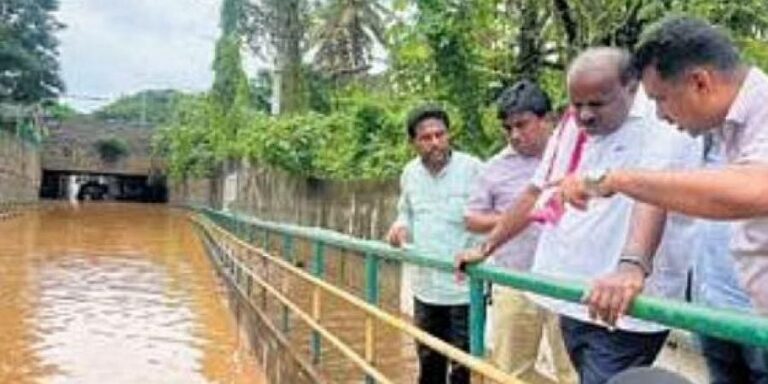
Several buses heading towards Mysuru were diverted by KSRTC on Monday due to heavy flooding on the busy Bengaluru-Mysuru Highway via Kanakapura-Harohalli and Malavalli. Meanwhile, a car belonging to former minister CP Yogeshwar was stranded at a railway underpass near Ramanagara. Local teams rescued the vehicle.
-
Ramanagara Police said that traffic was thrown out of gear and commuters coming to Bengaluru from Mysuru, and heading towards Channapatna, were stuck.
-
More than 10 bikes were washed away near Kumbalgodu. Villagers were seen fishing on the flooded highway. Former Chief Minister HD Kumaraswamy visited the inundated Bengaluru-Mysuru Highway in Ramanagara to review the situation.
-
A senior officer from KSRTC said that 249 buses were diverted from 8am, and around evening, they were allowed to take the Ramanagara route as the water was drained out. “We will monitor the situation for the next two days, and take a decision,” the officer said.
Copious rain, poor infra work leaves Karnataka flooded
Highlights
-
The severe flooding in Chamarajanagar, Ramanagara and surrounding areas is an unusual phenomenon, and locals and experts say this is the first time they have seen floods in the region in the past two decades. According to Karnataka State Natural Disaster Monitoring Centre (KSNDMC), till 8.30am, August 29, Ramanagara received 1039 per cent higher rainfall than normal, and Chamarajanagar received 1689 per cent higher rainfall than normal.
-
Ramanagara recorded 35mm rainfall against the normal of 3mm, and Chamarajanagar received 32mm against the normal of 2mm. In the past seven days (August 23-29), Ramanagara recorded excess rainfall of 495 per cent, and Chamarajanagar 378 per cent excess rain.
-
Officials and experts point out that the region has not experienced a dry spell or drought in the past three years. Due to increased infrastructure activities, excess rainwater is leading to flooding downstream in the Cauvery basin, leading to water stagnation.
-
“Unplanned and haphazard infrastructure work is the prime cause of flooding. The fertile cultivation area is flooding, which is a sign of poor planning. The Cauvery basin and downstream are not supposed to flood because of the natural terrain for water flow. As all the water bodies are full due to continuous rainfall since 2020 and 2021, matters have become worse. The areas leading to Tamil Nadu are also flooded.”
-
Officials from the India Meteorological Department (IMD) Bengaluru said Chamarajanagar recorded 7cm rainfall and Kollegal recorded 6cm rainfall on August 29. “The duration was through the day and intensity was not high. But since the regions have been continuously receiving rainfall and all water bodies are full, it would have led to flooding,” the official said. Officials from KSNDMC have now decided to undertake a detailed study on the ground water table. “So far, such a study was not undertaken to assess the situation, but now it is necessary to know how much more water the region can hold. This is important to ensure agriculture planning, crop pattern, diversion, usage of land and to plan ahead,” said a KSNDMC official.
In past week, Ramanagara records 495%, Ch’nagar 378% excess rain
Excess rainwater leading to flooding of downstream in Cauvery basin
Situation grim in Yalandur, Kollegal and Gundlupet taluks as tanks are full
More than 10 two-wheelers were washed away near Kumbalgodu
NHAI asked to install temporary drains along Bengaluru-Mysuru highway to prevent highway flooding

Highlights
-
Karnataka Chief Minister Basavaraj Bommai said that the state government has directed National Highways Authority of India (NHAI) to install a temporary drainage system along the affected parts of Bengaluru-Mysuru highway to prevent waterlogging during rainfall.
-
Directions were issued to district administrations not to wait for NHAI engineers to clear the water and use state government staff for the purpose. Districts were also asked to be alert to prevent any breach of lake bunds and prevent losses.
-
Relief of Rs 10,000 will be distributed to households affected by floods within 24 hours, Bommai said.
-
Bommai said that the highway was inundated as works were under progress. In order to address problems caused due to waterlogging in parts of the highway, police were directed to arrange alternate routes for vehicles.
-
“I have spoken to the (police) commissioners of Bengaluru and Mysuru, SPs of Mysuru, Mandya, and Ramanagara districts, and have asked them to coordinate (traffic movement). Directions were issued (Sunday) to arrange alternate routes for vehicles,” the CM said.
-
Meanwhile, the chief secretary was asked to chair a meeting with NHAI officials. “Works are incomplete in some stretches due to which the stretch of roads were inundated. Temporary drains are required,” Bommai said. Instead of waiting for NHAI engineers to address the problems, districts have been asked to take all measures to clear water from the road.
-
The CM said that he has also sought a report on losses to crop and property from DCs and instructed them to provide Rs 10,000 compensation for the affected. Surveys of collapsed houses in different parts of the state should be carried out and first instalment of compensation should be provided at the earliest.
-
As almost all lakes in Karnataka were full due to incessant rainfall from the last six months, Bommai said that district administrations were asked to monitor the water bodies. “If rains continue, there are fears that the lakes could breach. Measures should be taken to secure them and ensure that this does not happen,” he said.
Free medicine kits given to cancer patients in Bengaluru

Highlights
-
Poor lifestyle habits, alcohol, drugs and tobacco consumption have led to a rise in cancer cases, said Dr C Ramchandra, director, Kidwai Memorial Institute of Technology. Calling Bengaluru a drug hub, he said these habits are a major reason for all health issues, including obesity, infertility and cancer.
-
Speaking on the sidelines of the distribution of free medicine kits worth Rs 5,000 each to cancer patients on the occasion of the 54th Founder’s Day organised by Karnataka Cancer Society (KCS), Dr Ramachandra said consumption of tobacco among women has seen a steep rise in cases in the past few years.
-
Society president HV Suresh said all patients, including those from above and below the poverty line, are provided treatment without bias, be it surgery or chemotherapy medicines. The association also provides support to society and provides medicines at a 40 per cent discount, which has proved helpful. In all, 106 cancer patients were given free medicine kits, and 12 patients in Mysuru were given the free kits two days ago. Doctors and past presidents associated with the organisation were also felicitated.
Dr Ramachandra said it was important to cater to all strata of society, and schemes like Aarogya Karnataka and Ayushman Bharat had proved to be extremely helpful. Cervical cancer has reduced in recent times due to increased awareness about early testing, appropriate hygiene and the ills of child marriage.
The aim is to create awareness and help early detection of cancer, and provide appropriate treatment, he said.
Health, education road map needed in Karnataka

Highlights
-
The Karnataka Health Vision Group released its report titled ‘Advancing People’s health in Karnataka: Vision for Progress’ on Wednesday. It is a roadmap for health care for the next 25 years. It recommends an increase in the state’s investment in health care to 8% of the gross domestic product by 2025 from 4.7% in 2019. It focuses on better intervention, integration, implementation, innovation and investment. It also focuses on the three domains of strengthening public health systems, implementing health programmes and identifying emerging public health topics. The goals for 2030 and beyond include increasing the percentage of households covered by health schemes or health insurance and spending on health and social protection. Other goals include reducing undernutrition among children, anaemia among pregnant women and children under five, and the incidence of TB and HIV/AIDS.
-
However, despite a promising report for the future of the health sector, it leaves many aspects unattended. It includes the common person’s vulnerability to a highly corporate world of hospitals, the onslaught of which is forcing the closure of nursing homes which were affordable and accessible to the general public. It fails to deal with the high medical education costs, discouraging young graduate doctors from serving in rural areas. They prefer working in urban-centred corporate hospitals to be able to repay substantial education loans. It does not address the issue of how hospitals play on insurance to drive patients through unwanted tests, nor does it touch upon the various nexuses in the medical world that subject patients and families to untold financial miseries outside of insurance coverage.
-
Implementing the vision group’s recommendations will hold no meaning if prevailing malpractices in the medical field are allowed to continue in the background of increased investments and “corporatisation” of hospitals. The ruling disposition should understand the symbiotic nature of health and education, and structure future road maps by taking both into account simultaneously, not independently as has been done. This will ensure people’s welfare, happiness and better work productivity.