
Highlights
-
The Social Welfare Department is all set to serve dishes prepared using millets to students of Morarji Desai Residential Schools from September 1.
-
The move, which intends to improve nutrition among children, will be implemented in Uttara Kannada and Haveri districts on an experimental basis for a period of six months. About 8,500 students of Uttara Kannada and 13,500 students of Haveri districts will benefit from the initiative, according to sources.
-
The department will conduct a study to ascertain improvement of nutrition among children after six months.
-
One kilogram of millets will be allocated to each student per month. Four varieties of millets will be used to prepare different types of dishes. An amount of Rs 1.40 crore will be spent on the initiative. The department plans to expand the scheme across the state, added the sources.
-
“Ragi, proso millet, little millet and pearl millet have plenty of fibre, calcium, Vitamin D and minerals. Flour will be prepared using these millets, which will be supplied to the hostels and residential schools. Idli, dosa and bajji will be prepared using the flour to be served to students,” ZP CEO Priyanga M told DH.
-
“The department will subject students to blood investigation, haemoglobin level and weight tests before launching the scheme. These will be repeated after six months to ascertain improvement. Normally, children’s grow till the age of 18 years. Supply of nutritious food will help their physical and mental health,” Social Welfare Department deputy director Ajjappa Sogalad told DH.
Highlights
-
Karnataka has suffered loss of more than Rs 600 crore due to rain, Minister of Major and Medium Irrigation Govind Karjol has said.
-
Speaking to reporters during his visit to Kabini dam in H D Kote taluk on Sunday, Karjol said that roads, bridges and other infrastructure have been damaged due to heavy rains.
-
“The government has directed the officials to take up emergency works on war footing,” Karjol said.

Highlights
-
Prizes come in myriad forms. But this one was not the gift-wrapped type and had uniqueness written all over it.
-
The receiver of the experiential bonanza was Deekshitha, a second-year science student of Vivekananda PU College at Kota.
-
This weekend, she got to spend the entire day with Deputy Commissioner Kurma Rao, closely observing him carry out his administrative duties.
-
The girl received this rare prize after winning the district skill development department’s essay-writing competition on skill-based knowledge.
-
She accompanied the DC to a Krishnashtami event and a press conference he addressed.
-
Not just that. Deekshitha was picked from her house at Heroor in Brahmavara to the DC office in the bureaucrat’s vehicle and dropped back home in the same vehicle.
-
The deputy commissioner explained to the girl the nitty-gritty of his work.
-
In the evening, she attended a meeting with the DC of the skill development department. The DC made Deekshitha sit next to him and observe the proceedings.
-
Deekshitha told DH that she enjoyed watching the DC’s work from close quarters and learnt a lot about administrative procedures.
-
“The ever-smiling DC was kind enough to teach me how to work in a government office. It was truly a memorable occasion. Indeed, the day made me reflect on my future plans. A determination developed within me to attempt the UPSC exams to become an IAS officer. The position carries an aura, in that it allows the officer serve the people,” she said.
-
As for her immediate plans, Deekshitha wants to write NEET, for entrance to MBBS, after PUC.
-
Kurma Rao said he enjoyed teaching the ambitious girl the working of the bureaucracy.
-
“She was intelligent enough to understand the work,” he said.
-
He wished more such initiatives are taken so that students are inspired to excel in their area of interest. Rao said more such programmes will be organised to motivate students.

Highlights
-
If all goes well, Karnataka will be the first state in the country to reduce its dependence on petrol and diesel with the state government aiming to increase production of ethanol, which is allowed to be blended at 20 per cent with motor fuels. This will also likely bring down prices of petrol and diesel.
-
Karnataka, which ranks third among sugarcane-growing states in the country, is coming up with a new ethanol policy that will provide for bigger profits for sugarcane growers. Ethanol can also be used to make disinfectants, sanitisers, medical spirit and bio-compressed natural gas.
-
Udyog Mitra Managing Director Doddabasavaraju, who is in charge of facilitating these industries, said there is an increased demand for ethanol after the Union government stressed on blending 20 per cent of ethanol with petrol and diesel. But none of the states have been able to produce even 10 per cent of ethanol required, he added.
-
“The state government, to promote its production, is providing all facilities, including subsidies. Those interested in setting up ethanol plants can also get loans easily from banks,” he said.
Research on running vehicles on ethanol
“Oil supply companies, including Indian Oil Corporation and Bharat Petroleum, have come forward to blend ethanol with their products. If we start using ethanol, the country’s dependence on crude oil will come down,” he said. Also, research is on running vehicles purely on ethanol, which could be the future.
“When that becomes a reality, the demand for ethanol will further increase. We are gearing up to increase production and it will happen over the years,” he added. According to the data available with TNIE, in the last one year, the state government has okayed proposals to produce 5,185-kilo litres per day of ethanol from sugarcane at 18 production units.
Three of these projects will be set up at an investment of Rs 5,850.18 crore. Of the 18 companies, five have been granted approval to produce ethanol, not only from sugarcane but also from rice, corn and wheat bran.
“Now, ethanol is produced only when sugar factories run for four to five months a year. If ethanol can be extracted from grains with some additional machinery, these units can run and generate employment the entire year. It will also serve our purpose of increasing the production of ethanol,” Basavaraju said.

Highlights
-
A man claiming to be a Congress worker was arrested on Saturday for hurling an egg at Leader of Opposition Siddaramaiah’s car at Guddehosur in Kushalnagar.
-
The arrested Sampath, who was picked up by the police on the day he hurled the egg, had to be admitted to a hospital with serious health issues. The police conducted a search after his discharge and arrested him.
-
A video clip of Sampath from Somwarpet, who claimed to be a Congress worker and confessed to hurling the egg at Siddaramaiah’s car, had gone viral.
-
However, it was not clear who had shot the video and who was questioning the man.
-
In the video, he says, “I was angry at Siddaramaiah for his statement on Tipu and that people in Kodagu consume beef. I joined the protesting group and hurled an egg at the car.”
-
“I am a follower of Jeevijaya and was in the JD(S) when he was in the party. Later, when Jeevijaya joined the Congress, I followed him,” he said.

Highlights
-
Karnataka spent nearly Rs 30,000 crore on backward taluks based on the D M Nanjundappa Committee’s report. Only 12.5 per cent of this money went towards human development, a startling epilogue to a 15-year-old effort that has ended.
-
Last week, the Cabinet decided to replace backwardness indicators evolved by the Nanjundappa Committee with those used by the Niti Aayog for a new Aspirational Taluks Scheme.
-
Between 2007 and 2021, under the special development plan (SDP), Karnataka pumped in Rs 29,422 crore to 114 taluks identified as backward by the Nanjundappa Committee.
-
“Only 12.5 per cent of the allocation was provided for human resource development,” states the Cabinet note on the new scheme accessed by DH. This includes education (5.8 per cent), health (5 per cent) and women & child development (1.6 per cent).
-
Three-fifths, or 60 per cent, of the total SDP allocation went to five infrastructure departments — water resources (19 per cent), rural development (17 per cent), housing (11 per cent), public works (7 per cent) and energy (6 per cent).
-
This disparity in allocation led to “inequality” in human development, the note says. “…the human development index (HDI) in 112 taluks out of 114 backward taluks was less than the state average of 0.611. Only Anekal and Kalaburagi had shown improvement,” it states.
-
Economist Narendar Pani said the Nanjundappa Committee had “a fairly detailed set” of indicators. “That the SDP didn’t work is a valid argument. But I don’t agree that we need a new set of indicators. We need a strategy and ask why the SDP didn’t work,” he said.
-
Pani said Nanjundappa’s perception was to remove backwardness through overall development. “Yes, human development must be spent on. But the idea was to change the nature of the economy of the (backward) region,” he said.
-
In its 2002 report, the Nanjundappa Committee used 35 indicators under Agriculture & Allied Sectors, Trade Business & Finance, Economic Infrastructure, Social Infrastructure and Demographic Characteristics to identify 114 backward taluks. This will be replaced by 49 indicators of the Niti Aayog. Starting 2023-24, Rs 3,000 crore will be provided to taluks that are below the state average on these 49 indicators.
-
The government has also proposed quarterly performance-based cash incentives for aspirational taluks whose progress will be monitored every month — Rs 12.5 lakh to the first rank, Rs 10 lakh for the second and Rs 7.5 lakh to the third.
-
Former ISEC director M G Chandrakanth welcomed the adoption of new indicators. “Given that India is an infrastructure-poor nation, it is good that the focus was more on infrastructure. But much has changed since Nanjundappa’s time,” he said.

Highlights
-
Chief Minister Basavaraj Bommai on Saturday said he would approve Rs 250 crore to upgrade backward classes hostels in the state.
-
He spoke at the 107th birth anniversary of former chief minister D Devaraj Urs.
-
“I will approve Rs 150 crore needed for hostel repair and another Rs 100 crore for other works,” Bommai said.
-
He further announced that the government will increase the capacity of hostels by 25% this year. “The number of hostel students is going up. We’re increasing capacity by 25% for which funds will be given,” Bommai said, adding that there are 2,439 hostels in the state.
-
The government is setting up five hostels that can house 1,000 students each. “These hostels are coming up at Mysuru, Dharwad, Kalaburagi, Mangaluru and Bengaluru. My goal is to increase the capacity to 5,000,” he said.
-
In addition to four schools named after social reformer Narayana Guru being set up, each costing Rs 30 crore, Bommai said two more will be started due to high demand.
-
The government is also restarting a tailoring scheme for women named after Urs. “The scheme had stopped. We’re restarting it this year,” Bommai said.
-
Bommai hailed Urs as “a great leader, an able administrator and a champion of backward classes.”
-
According to Bommai, Urs took Karnataka to greater heights in politics. “Unfortunately, those for whom he sacrificed everything were not with him during his last days. This tragedy needs introspection,” he said.
On the occasion, the D Devaraj Urs award was presented to Mangaluru-based Dr Annayya Kulal.

Highlights
-
At least 52 aspiring teachers vying for jobs at government schools are facing an inquiry for alleged malpractices in the recruitment exam that was held recently.
-
The Department of Public Instruction has withheld results of these candidates and notices have been served to them.
-
These candidates wrote the Common Entrance Test (CET) that was held in May for the recruitment of 15,000 teachers in government schools. The results were announced recently. Of the 1.16 lakh candidates who applied, 52,342 were eligible for recruitment.
-
Authorities discovered unauthorised use of whiteners and change in handwriting. “Differences in handwriting, change of ink and use of whitener were caught during scanning of the OMR sheets before they were sent for evaluation,” a senior official said.
-
Authorities were also shocked to find that the desperate aspirants had written job requests on the answer scripts. “Some candidates wrote request notes on the answer sheets, urging evaluators to pass them so that they can get a government job,” the official said. “This was identified at the time of evaluation.”
-
Some candidates have replied to the notices issued by the department. “If the reason or explanation given by the candidate seems genuine, then we will call them in for inquiry. For example, in case of handwriting, we will make them write the exam,” the official said.
-
The department collected CCTV footage from all the exam centres where these 52 candidates wrote the CET. If they are found guilty, then they will be permanently disqualified.

Highlights
-
With the Congress in Karnataka all set to hold protests censuring the egg hurling incident against party stalwart Siddaramaiah, Chief Minister Basavaraj Bommai on Sunday said people should behave responsibly without challenging the law and order.
-
Addressing reporters here, he said, “We can function even when there are differences of opinion, but no one should challenge the law and order by taking to the streets.”
-
The CM said the incident in which eggs were thrown at Siddaramaiah’s convoy in Kodagu district was being investigated. He added that he has directed the police to investigate the matter thoroughly and provide adequate protection to Siddaramaiah. “… I have given instructions to give protection to the Leader of Opposition in the state assembly.
-
However, it is left to the political party on how much it wants to play it up and politicise it. I would like to say that peace and public order is every political party’s responsibility,” Bommai said. To a query on burning Hindutva ideologue Vinayak Damodar Savarkar’s photograph in some parts of Karnataka, Bommai said ideologies should be fought ideologically.
-
“It is a documented fact that former Prime Minister late Indira Gandhi had hailed Savarkar, calling him the best son of the country. Congress leader Manishankar Aiyar too spoke about Savarkar, for which he was criticised,” Bommai claimed. Referring to 18th-century Mysuru ruler Tipu Sultan, he said there were views expressed against and in support of him.
-
“These are historical facts. It is our responsibility how we refer to it on any given platform,” Bommai said. A group of BJP activists waved black flags and hurled eggs at Siddaramaiah’s car during his visit to Kodagu on August 18 to inspect rain-related damages in the region.
-
The Congress has decided to organise ‘Madikeri Chalo’ programme to protest against the incident tentatively on August 26.
Highlights
-
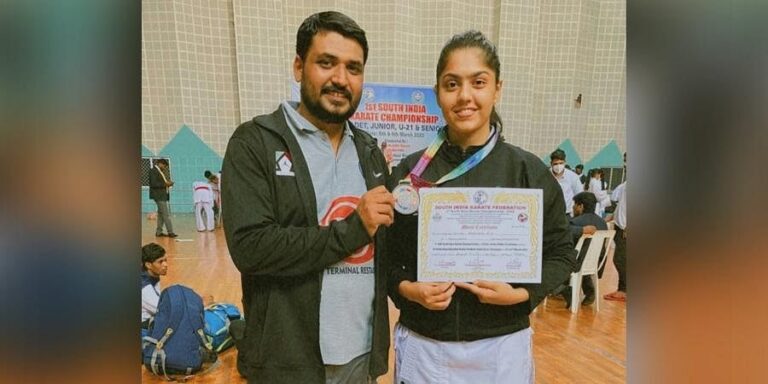
It i It is no secret that India is a cricket-crazy nation and it won’t be an exaggeration to say that life comes to a standstill when the Men in Blue are out on the field. But there are other sportspersons, too, who are trying to carve out a niche for themselves. India’s success in the recent Commonwealth Games at Birmingham when the Indian Tricolour was hoisted scores of times in less-popular sports is a testimony to this.
-
Opting for such sport is Ankita BT from Madikeri, who is kicking high with karate. Already a junior black belt holder, this 21-year-old has bigger dreams, not just for her, but for the entire nation. Her tryst with karate began as a nine-year-old. “Karate always seemed challenging and I started training,” she recalls. She says there were not many takers for karate among girls and felt the need to break the stereotype.
-
Ankita, who has been training at Phoenix Academy India in Bengaluru, made her debut at the national championship when she was in Class 8 and craved to achieve more. Since then, she has participated in the All-Indian Independence Cup in 2015, Bangalore Open Karate Championship in 2016, All-India Independence Cup in Goa in in 2016, All-Independence Cup, All-Indian Sports Extravaganza VIE in 2017, Intercollegiate Karate Championship in 2017, KAI Nationals, Indian Seiko Kai Karate Championship and more. She has won several gold and silver medals in many of these competitions.
-
“Karate is recognised by the International Olympic Committee, but not by the Indian Olympic Association. Though the Karate India Organisation supports athletes to take part in the World Championships and other Asian Championships that help us attain the World Karate Federation ranking, it does not fund the players. Expenses are covered only for the Olympics and Asian Games and we have to spend our own money to take part in other international events,” she adds. A South zone and a state medallist, she is also the vice-chairperson of Women’s Sports Commission of Akhila Karnataka Sports Karate Association.
-
She is now in Thailand participating in the Open Karate-Do Championship that started from August 19. “I have been training regularly and my ambition is to take part in more challenging championships. I also look forward to participating in the Karate 1 Series A at Kocaeli in Turkey and Karate 1 Series A Jakarta Indonesia Championships in September,” she says.
-
But sourcing funds has been the biggest challenge and seeks support from the state and sponsors to achieve her goal of representing India and Karnataka at these championships. She says she wants to educate girls on the need for self-defence and motivate more women to join the sport.
1...318319320...883Page 319 of 883
