KEY STORY
-
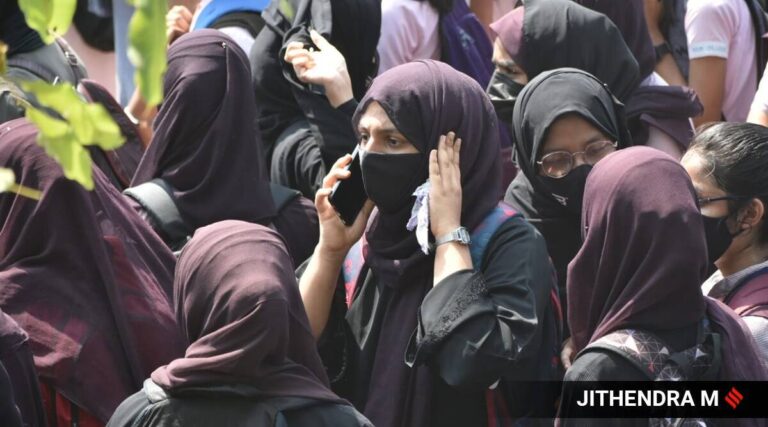
The girl students, protesting against restrictions on attending classes wearing hijab, said they would not be allowed to study if they decide not to wear hijab. A couple of girls, who spoke to mediapersons in Hassan on February 18, said their parents would not send them to schools if they give up the hijab.
-
“We are following the dress code. How will the veil on our heads affect others? We are appealing to college authorities to allow us in because we want education. Our parents will not allow us to go to college without hijab,” said a student of Government PU College for Girls in Hassan.
-
The college staff had asked girls with hijabs to sit in a separate room, instead of sending them home. “We were in a separate room with no teaching, while our other classmates were attending classes. Why should we not attend classes? If we are not allowed to attend classes, how can we appear for exams? We want both exams and hijab,” said one of the girls echoing the sentiment of the group.
Protest march
Protests against restrictions on hijab continued outside several schools while many students who had staged protests for the last couple of days remained at home. A few students of Karnataka Public School at Shiralakoppa in Shikaripur taluk marched around the school carrying placards proclaiming ‘Hijab is our right’.
MP blames PFI
Shivamogga Lok Sabha member B.Y. Raghavendra, in a media conference in Shivamogga on February 18, blamed Popular Front of India, SDPI and CFI for the unrest across Karnataka over the hijab issue. “The PFI should be banned for its involvement anti-social activities,” he said.
KEY STORY
-
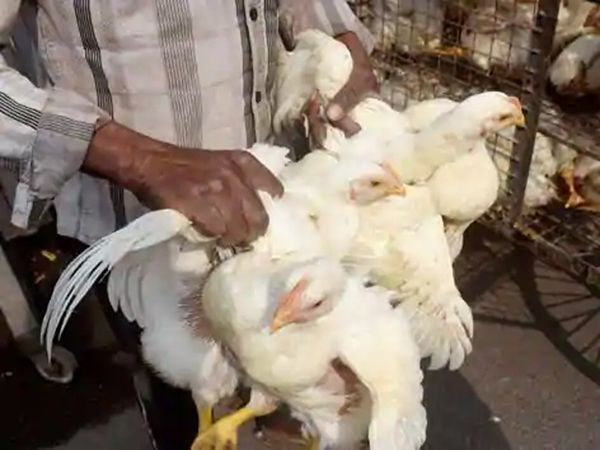
There has been a bird flu scare in Maharashtra. It has been reported that around 100 chickens died suddenly at a poultry farm in the state’s Thane district. Thane District Magistrate and Collector Rajesh J Narvekar said the chicken deaths took place in Vehloli village of Shahapur tehsil due to bird flu. The official said the animals’ samples were sent to a lab in Pune to confirm if it indeed was a case of bird flu. The results were positive.
-
Narvekar said as a precautionary measure, around 25,000 birds in a radius of a kilometre from the affected poultry farm will be culled within the next few days. “The district animal husbandry department has been ordered to take measures to control the infection,” the Thane DM stated.
-
Chief Executive Officer (CEO) of the Thane Zilla Parishad, Dr Bhausaheb Dangde, also confirmed that the birds had died due to H5N1 avian influenza.
CONCLUSION
-
The district authorities have informed the Union Ministry of Fisheries and Animal Husbandry about the detection of bird flu cases.
-
Bird flu, whose scientific name is avian influenza, is an infectious viral disease found in birds, largely among wild waterfowl like ducks and geese. Scientists say the virus is carried by wild birds without showing symptoms and it is transmitted to poultry through feathers or faeces.

KEY STORY
-
Actor Deepika Padukone, who is currently basking in the success of her film Gehraiyaan, talked about a possible film on her father Prakash Padukone, in a new interview. Deepika revealed that she is working on his biopic.
-
Deepika opened up about the challenges that her father Prakash Padukone, a former Badminton star, faced when he was training in his younger days. She also talked about how he was one of the first Indian sportspersons who made his mark on the global map.
-
Talking about a film on Prakash’s life, Deepika told Cyrus Broacha in an interview for his YouTube channel Cyrus Says, “I am working on it. Actually, even before 83 happened, he (Prakash) was one of the first Indian athletes to put India on the global map as far as Indian sports is concerned. He won the World Championship in 1981, which was obviously before 1983.”
-
In 2018, when The Badminton Association of India (BAI) conferred its inaugural Lifetime Achievement Award to Prakash, he had said at the event: “I played at a time when there weren’t many facilities. I played without the lure of returns, money, rewards or to even please my parents. I played for my own satisfaction and to see how much I can challenge myself.”
CONCLUSION
-
Prakash Padukone is a former world No.1 who had much success in the sport, especially without the facilities and sponsorship that players receive today, to win several major tournaments. His two most famous achievements are winning the bronze medal at the 1983 World Championships, and clinching the 1980 All England Open – the first Indian to do so on both occasions.
-
Deepika will be seen next in Rohit Shetty’s Cirkus, which also stars her husband Ranveer Singh. Her line-up of films also includes Fighter with Hrithik Roshan and Pathan with Shah Rukh Khan.

KEY STORY
-
In the last few years, Mohammed Siraj has emerged as one of the finest pacers in Indian cricket. Siraj has gone from strength to strength after making his international debut in Australia – where he played a key role in Team India registering its second successive Test series win on Australian soil. Former Indian skipper Virat Kohli has played a big role in Siraj’s career.
-
Speaking on The RCB Podcast, Siraj recalled an incident when he had invited his Royal Challengers Bangalore (RCB) team to his home for a biryani treat. The pacer was however heartbroken when Kohli told him he won’t be able to come due to a stiff back.
-
However, Kohli joined the RCB teammates who visited Siraj’s home which became news in the locality.
“I had invited everyone from RCB to my house for dinner. I went home straight from the hotel. When I called him (Virat) up, he said “I have a stiff back miyan, I can’t come.” I told him to rest. What more could I say. But, when everyone came, I saw him get off the car. Everyone was there, PP (Parthiv Patel) Bhai, Chahal Bhai. I just ran towards Bhaiya (Virat) and hugged him. It was the best surprise of my life. Because Bhaiya (Virat) had said he won’t come. It became news, Virat Kohli has come to Toli Chowki,” Siraj said.
-
Like most of Indian cricketers, Siraj too comes from a humble background where his father was an autorickshaw driver and he received a daily allowance of Rs 60 for petrol. Siraj recalled how his life changed completely ever since he started playing in the IPL.
“I only had struggles, my dad used to drive an auto, I only had a Platina. Dad used to give me 60 rupees for Petrol. I would manage with that to reach Uppal Stadium, which was quite far from my house. When I was selected for the IPL, all those struggles came to an end. Dad stopped driving the auto, mom stopped doing household work, we stopped living in rented accommodation, we bought a new house. I didn’t need anything else in life. All I needed was my parents to be happy in a house we own. IPL gave me fame, it taught me the ways to be in social circles from meeting and talking to so many people. I learned so much. It’s all because of IPL,” Siraj added.
-
Siraj was one of the three players retained by RCB after Virat Kohli and Glenn Maxwell. Kohli will not be leading RCB in IPL 2022 as he had announced his decision to step down as the captain following IPL 2021.

KEY STORY
-
Concerns about Covaxin availability and the cohort size for clinical trials on children are among the prime considerations holding back the opening up of Covid vaccination for younger age groups (those below 15 years), top government sources have told ThePrint.
-
Covaxin has been approved by the drug controller for use in the 2-18 years age group, based on its trial data, and is currently the only Covid vaccine that is mandated by the government to be used for those in the 15-18 year-old category, for whom vaccination has been opened.
-
According to the latest Statement from the Press Information Bureau, India has so far vaccinated 70 per cent of eligible children with one dose of the vaccine, while 24 per cent have received both doses.
-
Sources said Covaxin manufacturer Bharat Biotech’s “long and complicated process of vaccine manufacturing” has meant that the company is currently churning out only around 5.5 crore to 6.5 crore doses per month. To vaccinate the 7.5 crore population in the 15-18 year-old age group (estimate shared by health secretary Rajesh Bhushan in a letter to states last December) with two vaccine doses, India needs at least 15 crore doses of the vaccine.
-
Covaxin is also being used for precaution doses (third vaccine dose) for healthcare workers, frontline workers and senior citizens. Since India does not allow mixing of vaccines, those who have once received Covaxin shots — either for their first or second dose — can only be given the same vaccine for subsequent doses, so it is essential that sufficient stocks are maintained for that purpose too. In addition, there is a rising demand for Covaxin among those receiving their first doses, said health ministry sources.
‘Long and tedious manufacturing process’
When asked the reason for the delay in vaccinating younger children against Covid, a senior health ministry official, speaking on conditions of anonymity, said, “Where are the vaccines? Covaxin supplies are still in the 5-6 crore (doses per month) range. We have to ensure that we have enough for the ones that we have announced it for before opening up further vaccination and creating confusion. Also it is not as if Covaxin has stopped being used in adults.”
The official added: “We have to keep sufficient doses for the precaution shots and then there are a growing number of people asking for Covaxin when they come for their first shots. In adults about 8-10 per cent vaccines being given are of Covaxin, so that would be about two-three crore (doses) per month.”
In comparison, the Serum Institute of India-manufactured Covishield’s monthly output is currently in the 28-30 crore doses range, officials said.
Another health ministry official said that the reason the per month manufacturing figures for Covaxin varies between only 5.5- 6.5 crore, is that the manufacturing process for the vaccine is long and tedious.
“The key thing is to grow enough viruses in the lab and then to ensure that in each batch there is no live virus left. If there is even one live virus the entire batch needs to be discarded. Since the time they started upping the output, it has happened twice that the whole batch had to be discarded for this reason,” the official said.
Two vaccines approved for children younger than 15 years
Currently India has two Covid vaccines that can be administered in children younger than 15 years. While Covaxin has been approved for use in children aged as young as two years, ZyCoV-D — manufactured by Zydus Cadila — has been approved for those aged 12 years and above. However, the consensus currently is to use ZyCoV-D only for adults. While the vaccine has started reaching Bihar (the first state to get supplies), they are yet to be used in the government’s vaccination programme. ZyCoV-D is the world’s first DNA vaccine.
“It is a completely new platform so it makes sense to see how it goes in adults before giving it to children,” said an official. Another Covid vaccine, Corbevax, manufactured by Biological E, has also been recommended for use in younger children (below 15 years), but the vaccine is yet to be delivered.
“The first batches of Corbevax should start reaching the consignee points all over the country from 20 February. The Covid working group of the National Technical Advisory Group on Immunisation (NTAGI) has looked at Covaxin and Corbevax for younger children in only one meeting. There are some concerns about the Covaxin data in younger children because the cohort of children below 15 years is really small. It will be taken up by the group in subsequent meetings and we will see what recommendations come. If Corbevax is not cleared by them for use in younger children, we may administer that too in adults,” the official said.
The Bharat Biotech statement on Covaxin trials in children gives an age-wise break up of the cohort. “For the trial, 976 subjects were screened for SARS-CoV-2 by RT-PCR and ELISA testing. Out of these, 525 eligible participants were enrolled. Based on the age, participants were distinguished into three groups in an age de-escalatory manner. Group I consisted of children of age 12-18 years (n=175), group II consisted of children of age 6-12 years (n=175), and group III consisted of children of age 2-6 years (n=175),” it said. The “n=175” indicates each group had 175 participants.
Third dose concerns
Meanwhile, the question of whether or not precaution doses should be administered to all Indians regardless of their vulnerability is still being debated. A section of experts in the government feel that giving the third dose now — when the third wave is on the wane in most parts of the country — may limit India’s options for the future, especially if a newer variant arrives.
“One needs to understand how immunity works. For the vaccines we are using, the seroconversion is higher than say mRNA vaccines and the vaccine remains effective for longer. If we give a third dose now and pump up the immune system, we may not get the desired effect if another variant arrives eight-nine months from now. That is one side of the argument. We are still weighing all options and will go by the final decision,” said a senior government official.
Limiting third dose administration now may also make more Covaxin doses available for children who are yet to receive even the first two doses.
KEY STORY
-
A student was denied entry for wearing tilak at the Government Pre-University College in Indi on Friday.
-
According to sources, the college authorities asked the boy to remove the tilak before entering the college. When he refused, they asked him to go home. Angered students indulge in a verbal argument with lecturers.
-
As soon as the news spread, various Hindu organisations including Bajrang Dal activists gathered in front of the college and raised slogans against the college and teachers. A section of students boycotted classes.
-
Students claimed that the high court interim order restricted them only from wearing religious outfits and not from wearing tilak. The police soon rushed to the college and pacified the situation.

KEY STORY
-
The full bench of the Karnataka High Court hearing the case related to hijab row in educational institutions on Friday declined a plea to restrain live streaming of proceedings.
-
As soon as the proceedings began, senior advocate Prof Ravi Varma Kumar, representing Muslim girls questioning the ban on wearing hijab in classrooms, claimed that live streaming was causing a lot of unrest in the society as the observations were taken out of context.
-
According to him, the live streaming has become “counterproductive and children were put to hardship”.
-
However, Chief Justice Ritu Raj Awasthi said: “Let the people understand what is the stand of the respondents also.”
-
As a few more fresh petitions were filed, Justice Awasthi requested the petitioners that the counsels for the fresh petitions can take only 10 minutes so that respondents can also be heard.
CONCLUSION
-
The full bench of the High Court comprises Justice Awasthi, Justice J M Khazi and Justice Krishna M Dixit.
-
The High Court, in its interim order pending consideration of all petitions related to the hijab row, last week restrained all the students from wearing saffron shawls, scarves, hijab and any religious flag within the classroom.

KEY STORY
-
With the hijab issue in Karnataka is not ready to die anytime soon, a guest lecturer working in Karnataka’s Jain PU college (Tumkuru) has resigned from her job.
-
The restrictions over wearing hijab to educational institutions had triggered a massive row over the last few weeks.
-
The students and faculty in the state have been instructed not to wear any religious symbols inside the campus following an interim order last week by Karnataka High Court
-
Chandini Naz, an English lecturer at Jain PU College said “For the last three years, I am a guest lecturer at Jain PU college. In these three years, I have had no trouble at all and working comfortably. But yesterday morning our principal sir called us and told us that we shouldn’t wear the Hijab or represent any religious symbols and that they had orders.”
-
“So for the last three years I have been wearing the Hijab and conducting classes. This (restriction) was against my self respect so I have resigned on my own. I am not working without a Hijab in that college,” she added in a recorded video message that has gone viral on social media.
-
In her resignation letter, she had stated: “I condemn your undemocratic act.”
-
Meanwhile, around 60 final year students of the government G Shankar memorial women’s first-grade degree college in Udupi on Thursday returned home after they were told to take off their hijabs by college authorities.
-
Though the Muslim girl students argued with the authorities saying the chief minister has clarified that uniforms are not mandatory in degree colleges, the authorities said it is the college development committee that fixed the rules.
-
The girls, who insisted that they will not attend classes without the headscarves, said hijab and education are important to them.
-
They also wanted the college committee to give in writing if the state government has decided to introduce dress code in degree colleges.
CONCLUSION
-
A girl student who talked to reporters said the CM has made clear that hijab rule is not enforced in degree colleges. “When we asked about it, they say only college committee’s decision applies here,” she said.
-
She said hijab is part of their lives and they have been wearing it all along to classes. “It cannot be removed when someone suddenly asks you to do it. We have asked the college to hold online classes for us,” the student said.
-
The students said they will not attend physical classes till the High Court takes a decision on the issue. Classes are being conducted smoothly in the college. Police force has been deployed in the college premises to check any untoward incidents
KEY STORY
-
A leukaemia patient in the US has become the first woman and the third person to be cured of HIV, the virus that causes AIDS, after receiving a stem cell transplant, according to researchers.
-
In a presentation at Conference on Retroviruses and Opportunistic Infections (CROI) in the US on Tuesday, the researchers reported that the woman has had no detectable levels of HIV for 14 months despite cessation of antiretroviral therapy (ART).
-
Stem cells have the unique ability to develop into specialised cell types in the body.
-
This is the third known case of HIV remission in an individual who received a stem cell transplant, the National Institutes of Health (NIH) said in statement.
-
HIV remission resulting from a stem cell transplant had been previously observed in two cases.
-
The first, a Caucasian male known as the “Berlin patient”, experienced HIV remission for 12 years and was deemed cured of HIV. He died of leukemia in September 2020.
-
A Latino male called the “London patient” has been in HIV remission for more than 30 months.
-
This third case suggests that cord stem cell transplantation should be considered to achieve HIV remission and cure for people living with HIV who require such a transplant for other diseases, the study team said in the statement.
-
The research was conducted by the International Maternal Pediatric Adolescent AIDS Clinical Trial Network (IMPAACT) P1107 observational study led by researchers at the University of California Los Angeles, and Johns Hopkins University.
-
The IMPAACT P1107 study began in 2015 and was designed to describe the outcomes of up to 25 participants living with HIV.
-
The case described at the meeting involves a woman of mixed race ancestry who had been on ART for HIV infection for four years at the time of her acute myeloid leukemia diagnosis.
-
She achieved acute myeloid leukemia remission after chemotherapy. Prior to receiving the stem cell transplant, the participant’s HIV was well-controlled but detectable.
CONCLUSION
-
In 2017, she received a transplant of cord blood stem cells supplemented with adult donor cells from a relative.
-
After receiving the stem cell transplant, she engrafted with 100 per cent cord blood cells at day 100 and had no detectable HIV, the researchers said. At 37 months post-transplant, the patient ceased ART, they said.
-
According to the study team, no HIV was detected in the participant for 14 months except for a transient detection of trace levels of HIV DNA in the woman’s blood cells at 14 weeks after stopping ART.
KEY STORY
-
COLLEGES ACROSS Karnataka reopened under heavy police cover Wednesday to chaotic scenes outside several institutions with authorities refusing entry to hijab-wearing students prompting several girls to return home without attending classes.
While college authorities cited the Karnataka High Court’s interim order last week, banning religious symbols until it decides on pleas challenging the hijab ban in some colleges of Udupi, several students said the restrictions were applied indiscriminately.
-
Despite the hijab becoming an issue all over the state, it was never a concern in our college. But today, they asked all of us to remove our hijabs and come. Before our college was shut last week, along with others in the state, we used to wear hijabs and attend class. Today, those who refused to remove their hijabs were made to sit in a separate classroom,” said a first-year BBA student from the G Shankar government women’s first grade college at Ajjarkad in Udupi.
-
The college’s principal, Bhaskar Shetty, said he was “following the court order”. “There are 196 Muslim students out of 2,326 girl students in the college, and only 40 were against removing hijabs. We will take a decision about making alternative arrangements for those who refused to attend classes without hijabs,” Shetty said.
-
Even as the Karnataka High Court continued to hear petitions against the ban, the issue echoed in the state assembly where it was raised during Zero Hour by Leader of Opposition Siddaramaiah.
The Congress leader sought a clarification from the BJP government on a statement made by the state’s Higher Education Minister Dr C N Ashwathnarayan on Tuesday that the High Court’s restrictions would not apply to degree colleges.
-
Responding in the House, Chief Minister Basavaraj Bommai said: “The High Court order will be followed in all colleges. The High Court has said that only in colleges where uniforms are prescribed will the ban apply.”
Bommai stated that as per the High Court’s interim order of February 10, the restrictions apply only in pre-university colleges where uniforms without headscarves have been prescribed.
When contacted by The Indian Express to ask why students were not allowed inside degree colleges in Udupi, Sadhashivaprabhu, additional deputy commissioner of the district, said: “I don’t want to comment on the issue.”
Officials said the six students who had moved the Karnataka High Court against the hijab ban remained absent from the Government Pre-University College for Women in Udupi. “The other Muslim students attended the college by adhering to the court’s order,” said Rudre Gowda, the principal.
The 23 girl students who had insisted on wearing hijabs at the Government PU College in Udupi’s Kundapur stayed away from classes, too.
-
Classes did not resume at the other hotspot in the district, MGM College in Manipal, where groups of students — those wearing saffron shawls and others wearing hijabs — had gathered to raise slogans on campus over the row. College authorities said they had declared an extra day’s holiday on Wednesday.
The state government had shut all colleges from February 9 to cool communal tensions over the hijab row. On Wednesday, there were minor protests outside some colleges where hijab-wearing students were denied entry with policemen deployed near campuses at sensitive locations — especially in Udupi and Mysore where prohibitory orders were enforced within 200m of educational institutions.
CONCLUSION
-
At DVS College in Shivamogga, hijab-wearing students said they were not allowed to appear for internal exams. “Today was our test, and we are not allowed to go in. For us, practising our faith is as important as education and hijab is part of our faith,” a student told reporters.
In Vijayapura, students in burqas were not allowed inside campuses. Similar incidents were reported from Kalaburagi, Yadgir, Chikmagalur, Vijayapura, Gadag, Hubballi, Chitradurga and other parts of the state.
-
The faceoff also triggered a war of words between the Bajrang Dal and SDPI, which is the political arm of the radical PFI, with both blaming each other in press conferences held in Udupi for the escalating tensions over the issue.
State Home Minister Araga Jnanendra warned students that they would face “stern action” if the High Court’s interim order is not followed. “We had adopted a soft approach over these days, considering they are students, but it won”t be so any more,” he said.
-
In its interim order, the High Court had said that “pending consideration of all these petitions, we restrain all the students regardless of their religion or faith from wearing saffron shawls (bhagwa) scarfs, hijab, religious flags or the like, within the classroom, until further orders”.
-
It said that the order “is confined to such institutions wherein the College Development Committees have prescribed the student dress code/ uniform”.
1...422423424...883Page 423 of 883