States, UTs advised to train vaccinators for inoculation of children aged 15-18 years

KEY STORY

  • Union Health Ministry has advised states and Union territories to train vaccinators for the administration of vaccines to children aged 15-18 years.
  • The ministry also advised that dedicated centres can be established for the same, and only Covaxin will be administered with a proper training, ANI reported, citing sources.
  • COVID-19 vaccination of children in the age group of 15-18 years will be started from January 3 next year. The estimated population to be covered in this category is seven to eight crores.
  • Making the announcement on Saturday, Prime Minister Narendra Modi said this will reduce the worries of children going to schools and colleges and their parents, and boost the fight against the pandemic, adding that the move is also likely to aid in normalisation of teaching in schools.
  • Bharat Biotech’s Covaxin will be the only COVID-19 vaccine that will be administered to children between 15 to 18 years age group from next month, according to new guidelines issued by Union Health Ministry.
  • “For all those aged 15 years or more, option for vaccination would only be available for Covaxin as this is the only vaccine with Emergency Use Listing (EUL) for the age-group 15-17,” the ministry said in its guidelines issued on Monday.

CONCLUSION

The guidelines will come into effect from January 3 and will be reviewed from time to time.
All those aged 15 years or more will be able to register on Co-WIN. Beneficiaries can self-register, online through an existing account on Co-WIN or can also register by creating a new account through a unique mobile number, this facility is available for all eligible citizens presently.
Such beneficiaries can also be registered onsite by the verifier/vaccinator in facilitated registration mode, the guidelines read. Appointments can be booked online or onsite (walk-in).

Delhi CM Arvind Kejriwal condemns ‘police brutality’ on resident doctors during protest over NEET 2021 counselling

KEY STORY

  • Chief Minister Arvind Kejriwal on Tuesday wrote to Prime Minister Narendra Modi condemning the alleged ‘police brutality’ on resident doctors in the national capital over the delay in National Eligibility Entrance Test postgraduate (NEET PG) counselling 2021.
  • Several resident doctors across India began a protest march on Monday and continued their agitation even today and warned to pull back “all healthcare services” from Wednesday.
  • “Doctors have been protesting for several days. These are the people who risked their lives during the Covid-19 outbreak to serve citizens. The pandemic is still raging. They should be in hospitals and not on the streets. We strongly condemn the police brutality inflicted on them. I request the Prime Minister to accept their demands at the earliest,” Kejriwal said in his tweet.

  • The Federation of All India Medical Association (FAIMA) has called for complete pull out from all healthcare services across India from 8 am on December 29 “in protest against brute force by Delhi Police against doctors”.
  • The protest comes at a time when India is grappling with a resurgent Covid-19 outbreak due to the Omicron variant, which is reportedly resistant to the vaccine and has a spike protein worse than the Delta strain that wreaked havoc across the country during the second wave of the pandemic from April-June this year.
  • The Federation of All India Medical Association (FAIMA) has called for complete pull out from all healthcare services across India from 8 am on December 29 “in protest against brute force by Delhi Police against doctors”.

CONCLUSION

  • Union Health Minister Mansukh Mandaviya met representatives of the protesting doctors at Nirman Bhavan in Delhi today and requested them to call off their strike “in public interest”.
  • Doctors have also sought an official apology from the Delhi Police over their “stern action” during Monday’s march to Supreme Court.
  • “We want respect. This is now our foremost demand. We want an apology from the police over their brutality on our fellow doctors,” a protesting doctor told news agency IANS.

Delhi Schools, Colleges closed with immediate effect as Government sounds Yellow Alert over rising cases

KEY STORY

  • Delhi Schools have been closed again. Delhi Government today sounded the yellow alert, kickingi into place a seriers of restrictions to manage COVID-19 spread in the city. Within the restrictions, the government has included shutting down of schools and colleges in the city. The move comes after Delhi Government today issued Yellow Alert, as case positivity touched 0.5%.
  • With the yellow alert, the schools are to be shut down in the capital again. A meeting was called today after the positivity rate remained at 0.5% for the second consecutive day today. In accordance to the Graded Response Action Plan, GRAP measures suggested, the government has now decided put in place the restrictions under the GRAP Yellow Alert.  Along with schools and colleges, all academic institutions would also be closed. Apart from that, all cinema halls would also be closed while malls would be permitted to operate in a odd-even manner. Offices would fucntion as per the mandates, with maximum 50% capacity.
  • The city recorded as many as 331 new cases on Monday, which pushed the positivity rate above the 0.5%. As per GRAP, the city was to call on Yellow Alert on the situation, prompting the shutting down of schools.

CONCLUSION

  • “Although COVID-19 cases are rising in Delhi and positivity rate has breached the 0.5 per cent mark but hospitalisations are very low and fatality rate is negligible. Any decision about implementation of ‘Yellow’ alert restrictions will be taken after further discussions,” an officer had noted on Monday.
  • Taking the call, the government would be releasing the details, which would decide to shut the schools as a preventive measure. This comes a day after Delhi Government announced winter vacations in Delhi from January 1 to January 15. No online or offline learning activities are allowed in schools during this period.

COVID-19: Karnataka imposes night curfew for 10 days from Dec 28 as Omicron triggers alarm – details here

KEY STORY

  • In view of a possible third wave of coronavirus pandemic amid a surge in cases of the new variant Omicron, the Karnataka government has decided to impose a 10-day-long night curfew in the state starting December 28.
  • According to Karnataka Health Minister K Sudhakar, the night curfew will be imposed between 10 pm to 5 am.
  • “From December 28 onwards, for about ten days, to begin with, we would like to watch by calling a night curfew, invoking Section 144, from night 10 pm to the next morning 5 am,” PTI quoted the Karnataka Health Minister as saying.
  • The health minister further announced that the state government has completely banned all kinds of New Year-related parties and gatherings. “There will be no functions, parties in the external premises, especially for those celebrating with DJs and large gatherings, they have been completely banned in Karnataka,” he said.
  • He said that eating joints, hotels, and pubs are allowed to operate with only 50 per cent of their seating capacity.

Karnataka’s Omicron tally rises to 38

As many as seven more cases of Omicron variant were reported in Karnataka on Saturday, taking the tally of new mutant stain in the state to 38, informed Sudhakar.
Of these seven, two had travelled from Delhi, one had arrived from the United States of America, one each from Zambia, the United Kingdom, United Arab Emirates, and another is a primary contact of the UK traveller.

 

Senior Minister Ashoka dismisses talk of leadership change in Karnataka

KEY STORY

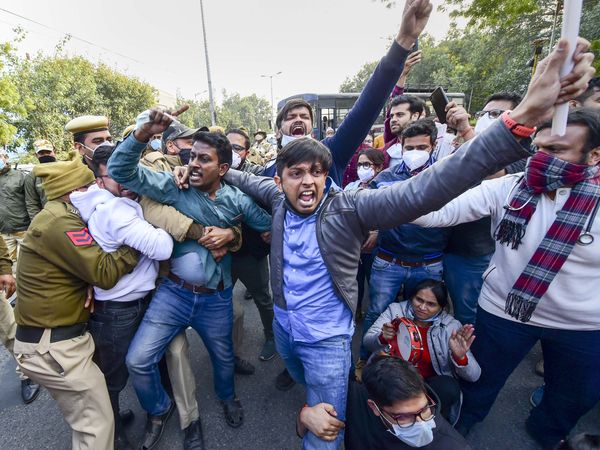
  • Seeking to put an end to speculation about possible leadership change in Karnataka, Revenue Minister R Ashoka on Friday said the BJP would face the next election under the leadership of Chief Minister Basavaraj Bommai.
  • There were rumours in some quarters in recent times that Bommai may go abroad for knee operation.
  • “We will face the next election under his (Bommai) leadership. There is no doubt about it. He is 100 per cent our leader,” Ashoka told reporters. The minister dismissed as “mischief” the rumours of Bommai going abroad for his knee operation.
  • He said doctors have advised him that he will be cured here in India without operation

India vs South Africa: Will Virat Kohli & Co. change 5 bowler combination? Vice captain KL Rahul responds

KEY STORY

  • India’s newly appointed vice-captain KL Rahul has hinted at sticking with the five bowlers combination during the upcoming series against South Africa. The first Test is set to begin on Boxing Day (December 26) at the SuperSport Park in Centurion. Under the captaincy of Virat Kohli, India has persisted with the five-bowlers combination on more occasions than not.
  • In the last three games of the away tour to Australia and the entire series in England earlier this year, India opted for this combination which has proved to be extremely successful. However, with the arrival of new head coach Rahul Dravid and injury to star all-rounder Ravindra Jadeja, there are doubts whether Kohli will stick with the combination against the Proteas.
  • In a pre-match press conference, Rahul said, “I think most teams have started playing five bowlers and every team wants to pick up 20 wickets and that’s the only way you can win a Test match. We have used this tactic and it has helped us in away games.”
  • He further stressed on the importance of the five-bowlers combination to assist in managing workload especially with the quality of bowlers present in India’s ranks. “In every Test match that we have played away from India, it has helped us. So, workload also becomes slightly easier to manage that way with five bowlers and when you have that kind of quality, you might as well use them,” said Rahul.
  • If India decides to play with five bowlers, it is likely to confirm both Ravichandran Ashwin and Shardul Thakur’s place in the playing XI who will have increased responsibility to deliver the goods with the bat.
  • Rahul was elevated to the role of vice-captain after Rohit Sharma’s withdrawal from the squad due to a hamstring injury. Rohit was named as Kohli’s deputy for the first time in the longest format of the game ahead of this series. The Indian white-ball skipper had replaced Ajnkya Rahane in the role amid increased scrutiny over his place in the team.


COVID-19: India records over 100 new Omicron cases, highest single-day rise so far; tally reaches 358

KEY STORY

 India on Friday witnessed the highest single-day spike of the new Omicron variant of coronavirus with more than 100 infections of the new mutant variant reported in the last 24 hours in the country, as per the latest bulletin by the Ministry of Health and Family Welfare (MoHFW).
Maharashtra has recorded the highest number of 88 cases of the Omicron variant, followed by Delhi with 67, Telangana 38, Tamil Nadu 34, Karnataka 31, and Gujarat 30.
Meanwhile, the Union Health Ministry has informed that a total of 6,650 new COVID-19 cases, 7,051 recoveries, and 374 deaths were reported in the country in the last 24 hours. With this, the death toll has surged to 4,79,133, while the active cases stand at 77,516.
A total of 3,42,15,977 COVID-19 patients have successfully recovered from the illness in the country so far, the health ministry said.
Statewise tally of COVID-19
S. No.
Name of State / UT
Active Cases*
Cured/Discharged/Migrated*
Deaths**
Total
Change since yesterday
Cumulative
Change since yesterday
Cumulative
Change since yesterday
1
Andaman and Nicobar Islands
6
3
7573
1
129
2
Andhra Pradesh
1326
32
2060400
164
14486
3
3
Arunachal Pradesh
18
3
55030
7
280
4
Assam
2249
20
611530
132
6153
1
5
Bihar
83
4
714228
13
12094
6
Chandigarh
97
2
64567
13
1078
7
Chhattisgarh
302
9
993619
28
13596
1
8
Dadra and Nagar Haveli and Daman and Diu
3
2
10684
2
4
9
Delhi
684
60
1416846
57
25103
1
10
Goa
429
37
175951
17
3518
11
Gujarat
668
31
818129
78
10108
2
12
Haryana
318
20
761992
26
10062
13
Himachal Pradesh
420
46
224178
80
3871
14
Jammu and Kashmir
1319
11
334456
118
4518
3
15
Jharkhand
236
35
344316
9
5142
16
Karnataka
7146
21
2958117
318
38301
2
17
Kerala***
27283
1236
5155142
3427
45861
323
18
Ladakh
201
5
21617
19
218
19
Lakshadweep
7
1
10355
51
20
Madhya Pradesh
191
11
782859
19
10531
21
Maharashtra
11578
547
6500375
615
141392
17
22
Manipur
192
4
123494
11
1999
1
23
Meghalaya
80
3
83212
2
1481
24
Mizoram
1713
134
138006
245
535
25
Nagaland
83
31389
2
702
1
26
Odisha
1665
18
1043391
172
8448
1
27
Puducherry
146
127348
8
1880
28
Punjab
314
9
587142
24
16636
1
29
Rajasthan
245
27
946125
12
8961
30
Sikkim
82
3
31979
3
409
1
31
Tamil Nadu
6889
90
2698628
689
36707
8
32
Telangana
3596
14
672637
190
4018
1
33
Tripura
58
10
84110
16
829
1
34
Uttarakhand
220
36
337062
3
7415
35
Uttar Pradesh
236
20
1687645
12
22915
36
West Bengal
7433
9
1601845
519
19702
6
Total#
77516
775
34215977
7051
479133
374
*** For Kerala, as per State media bulletin: 54 deaths reported on 23rd December +269 deaths declared as per appeal G.O.(Rt) No.2110/2021/H&FW
*(Including foreign Nationals)
**( more than 70% cases due to comorbidities )
#States wise distribution is subject to further verification and reconciliation
#Our figures are being reconciled with ICMR
PM reviews preparedness amid Omicron surge
Amid a surge in Omicron cases, Prime Minister Narendra Modi on Thursday chaired a high-level meeting and reviewed the efforts to combat the new COVID-19 strain.
He emphasised the need to be “satark” and “saavdhan” in view of the new variant. Fight against the pandemic is not over and the need for continued adherence to COVID safe behaviour is of paramount importance even today, the prime minister said.
“In view of the new variant, we should be ‘satark’ (alert) and ‘saavdhan’ (cautious),” he added.

‘Night curfews won’t help, don’t need booster doses against Omicron’, says top epidemiologist

KEY STORY

  • The night curfews are back as test positivity rates spike in some parts of India. Restrictions have also returned for large gatherings. But will these restrictions really help in halting the spread of Omicron, the Covid-19 variant that infects at a much higher rate than the Delta? Experts believe it is unlikely that restrictions will curb the spread of Omicron. Moreover an Omicron wave will not have much impact.
  • ” This particular wave is unlikely to be of any harm to us for several reasons”, says leading epidemiologist Dr JP Muliyil who is also a member of the NTAGI that has to decide on booster doses and children’s vaccines in India.
  • Dr Muliyil explains that the Omicron is manifesting as a very mild flu and enumerates the reasons that the Omicron may not be a big concern. First is the fact that it infects the upper respiratory tract unlike the Delta that impacted the lungs. Secondly, he believes eighty percent of people in India have already been exposed to Covid and the vaccines that have been given are working like booster doses. While preparation for large number of infections is necessary, there is no need for major restrictions he believes.
  • “These efforts are only going to inconvenience people and have no impact on the speed at which it travels”, he says. Meanwhile,the focus of additional doses of the Covid 19 vaccine are likely to be restricted to the elderly, vulnerable and immunocompromised.

Maharashtra govt announces new COVID-19 guidelines – Check details

KEY STORY

  • A day after Chief Minister Uddhav Thackeray held talks with the members of the state COVID-19 task force, the Maharashtra government announced new COVID-19 guidelines.
  • With Christmas festivities, weddings, and New Year’s receptions likely to increase the risk of contamination, the Disaster Management Act, 2005 has decided to impose some additional restrictions on the entire state which will be in effect from midnight today.
  • As per the new directive, a gathering of more than 5 persons in public places across the state is prohibited from 9 pm to 6 am.
  • Only 100 people will be allowed in indoor weddings and not more than 250 in outdoor weddings.

    Restaurants, gyms, cinema halls to operate at 50 per cent capacity

    Restaurants, gyms, spa, hotel, theatre and cinema halls will now operate at 50 per cent capacity and as per the state government, all of them will have to declare their full potential as well as 50 per cent capacity.
    For other social, political, religious events also the number of attendees should not be more than 100 and in open space, this number should not be more than 250 or 25 per cent of the capacity of the space whichever is less.
    In case of other social, political or religious functions and gatherings, where the presence of attendees is generally continual throughout the function, the total number of attendees should also not exceed 100 for enclosed spaces and 250 for open to sky spaces, or 25 per cent of the capacity of such spaces, whichever is less.
    Further restrictions should be considered in the future: CM
    In the case of sports events or competitions, these may be held with the number of spectators not exceeding 25 per cent of the seating capacity of the venue, the notification read.
    The number of patients is doubling, especially in Europe as well as in the United Kingdom, due to the Omicron variant.
    The current nature of the restrictions is preliminary and if they are not imposed now, it may be time to impose more stringent restrictions in the future, the notification read and urged people to follow the rules and use masks properly.
    Any shop, establishment, mall, event, gathering where a member of the public has a right to come and get services must be manned by fully vaccinated persons and all visitors, customers for such places shall be fully vaccinated.

No discussion, solutions for North Karnataka, rues Opposition

KEY STORY

  • A huge protest by Congress members, demanding time to discuss developmental issues of North Karnataka, brought down the curtains on the two-week winter session with Water Resources Minister Govind Karjol responding on the issue. It was expected that the session  would devote time to discuss developmental issues of backward North Karnataka and come up with solutions for regional imbalance. But a half-day discussion in the Assembly did not throw up any solutions.
  • Taking part in the discussion earlier, Opposition leader Siddaramaiah alleged that then deputy PM L K Advani had rejected the demand for special status to Hyderabad-Karnataka region. But in 2013, PM Manmohan Singh gave special status (Article 371J) .
  • To address regional imbalance, CM S M Krishna formed the Prof Nanjundappa Commission, and Congress governments have released Rs 29,942 crore since 2007-08, he said. Listing the BJP’s failure to keep its election manifesto promise, he said the party claimed to have release Rs 1.5 lakh crore for irrigation projects but had released only Rs 33,835 crore. He also claimed that in 2013, BJP promised to spend Rs 50,000 crore on irrigation but spent Rs 51,217 crore through their five-year rule.
  • When Siddaramaiah demanded more time to discuss the Mahadayi, Tungabhadra  and other irrigation projects of North Karnataka, Speaker Vishweshwar Hegde Kageri declined, saying the House was to be adjourned after the first session, which led to the protest.
  • Karjol said that the Congress government was responsible for drought and underdevelopment in the region for many decades as it had not agreed to give Rs 2 crore to complete the Koyna Dam to supply water to North Karnataka.